
Amazon links are affiliate links. As an Amazon Associate I earn from qualifying purchases. If you buy through these links, we may earn a commission at no extra cost to you. Affiliate disclosure.
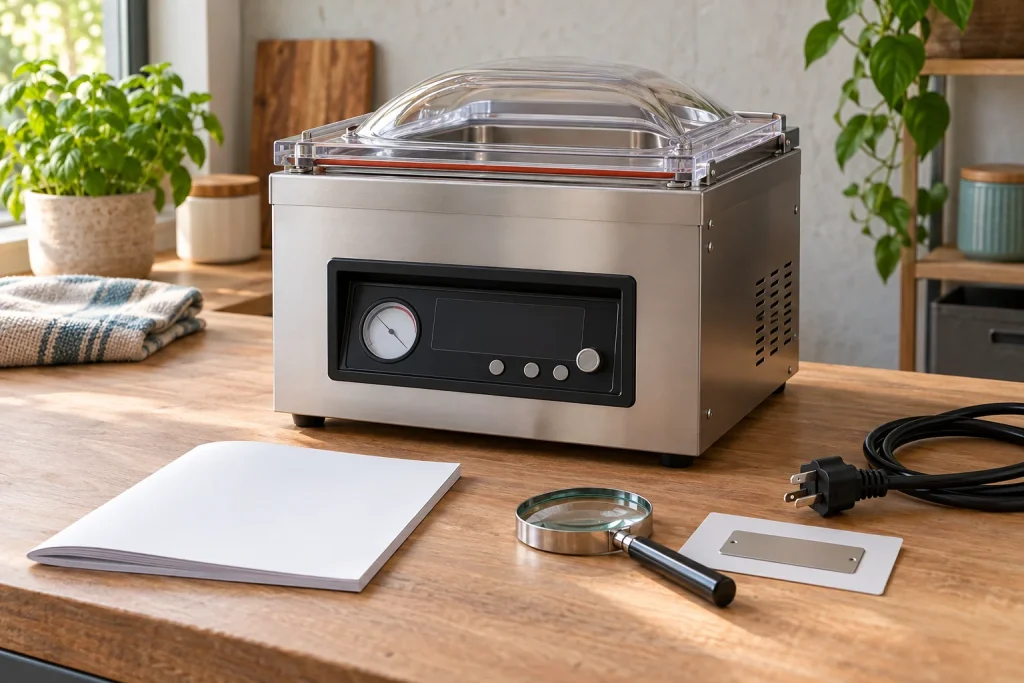
The VEVOR DZ-260C is a budget-minded chamber vacuum sealer worth considering when you need a 320 mm sealing bar and can accommodate a heavy, oil-pump machine. For US buyers, the manufacturer’s current DZ-260C-V1 product page specifies 120 V, 60 Hz. The family manual also describes V2 and V3 230-volt variants, so the model suffix is essential. This review focuses on the documented V1, not a generic promise about any listing labeled DZ-260C.
The retrieved Amazon record now corroborates that family name, but it does not conclusively establish the exact V1 suffix and specification set for the selected offer. The purchase recommendation remains on hold until revision, voltage, support and offer checks are complete.
Quick verdict
Quick verdict: Consider the US DZ-260C-V1 when price and a 12.6-inch sealing bar matter more than low weight and low-maintenance operation. Confirm the complete V1 model and 120-volt label before purchase.
- Best for: a dedicated food-packaging station, including larger batches where an oil-pump chamber design makes sense.
- Advantages: 320 mm seal bar, documented 355 × 340 × 70 mm chamber and adjustable vacuum/seal/cool stages.
- Trade-offs: approximately 60.8 lb product weight including accessories as listed, oil maintenance, shallow chamber height and differing published maximum-power figures.
View the VEVOR DZ-260C-V1 model and current offer
The identity record
| Source | What it establishes | What remains open |
|---|---|---|
| Current manufacturer product page | Identifies DZ-260C-V1 and its listed specifications | Match to selected marketplace unit |
| Manufacturer family manual | Covers V1, V2 and V3 with electrical distinctions | Correct revision and document for the actual unit |
| Amazon B08ZDJTCC4 record | Identifies the DZ-260C family in model details | Exact revision, seller and delivered configuration |
Sources: VEVOR product record, family manual and Amazon model record, checked on 30 October 2026. This is not evidence that any seller delivers the wrong product; it is an incomplete mapping that needs clarification.
Do not compare unlike power numbers
The current manufacturer product record states 1700 W maximum power, while the retrieved family manual lists 1800 W maximum power and separately identifies pump power. A listing also uses sealing-power wording.
Those figures must not be mixed into a single authoritative specification. Some describe different components; the maximum-power difference also needs a revision or manufacturer explanation. A 320 W sealing statement and a pump figure are not automatically contradictory because they may describe different loads.
Read the actual rating label and matching manual before electrical planning. Do not choose an adapter, extension lead or supply arrangement from a convenient number in a roundup.
Voltage and country version
The family manual distinguishes supply versions. Confirm the full voltage and frequency on the actual unit, not simply the apparent plug or a generic 110-volt listing phrase.
A familiar model-family name can cover equipment intended for different electrical supplies. If the seller cannot provide the applicable label and document, keep the purchase conditional.
Our model-identification worksheet gives a practical record to request. Do not assume a country selection on a shopping page certifies the physical unit’s electrical suitability.
Chamber fit still decides usefulness
The current V1 product record publishes a chamber layout and a sealing-length figure. Use them only after matching the revision, then check a loaded pouch with the correct opening orientation.
A broad chamber can still impose a height or placement restriction. The sealing assembly, clean neck and the way food changes the flat pouch dimensions matter.
Use the sizing guide rather than converting a gallon description into a food-capacity promise. Ask for a comparable loaded demonstration when the fit is close.
Oil-pump ownership needs preparation
The manufacturer family manual identifies an oil-pump design and setup requirements. Obtain the exact approved oil, level-check instructions and service routine for the unit offered.
Do not copy another chamber machine’s fill amount. A supplied oil bottle is not evidence that every drop belongs in the pump. Initial setup and later oil changes are separate tasks.
Also determine the service boundary. A parts diagram or tool in the box does not automatically make internal electrical work an ordinary owner task. Use manufacturer support for unclear or abnormal operation.
Controls and session expectations
The manual separates vacuum, sealing and cooling selections. Those settings address different stages, and its example starting values should not become universal food or film instructions.
Match the current control panel and material. A longer heating interval does not fix a contaminated opening and can damage a pouch or consumable. A longer vacuum interval does not prove a higher-quality finished package.
Ask for the model’s supported batch and rest requirements. Do not infer continuous production from an oil pump or a commercial description. The duty-cycle guide explains the full-session calculation.
Where the value case could be real
The model deserves investigation when its verified package fit, documented workload, service support and total delivered cost meet a genuine requirement. A lower equipment price can matter when those basics are satisfied.
The value case weakens if the model is uncertain, critical parts are hard to identify or the work area requires expensive adaptation. An inexpensive unit with unclear support can create a costly ownership problem.
Use the ownership worksheet with honest assumptions. Do not assign a lifespan, low failure rate or guaranteed food savings merely to justify the purchase.
What to request from the seller
Ask for the full model and revision, electrical label, applicable manual, included accessories, warranty eligibility and service route. Confirm whether the unit is new, refurbished or used and whether delivery terms suit the installation.
For a product comparison, retain unresolved figures rather than silently choosing the most attractive version. We are not quoting current Amazon prices, available sellers or stock in this review.
Alternatives to compare
Use the bulk-processing shortlist if sustained batches drive the decision. Use the compact shortlist if handling and small portions are more important.
Compare exact machines on the same package and complete workflow. A known-model alternative may be worth investigating if this revision mapping remains unresolved, even if its headline price is higher.
Questions buyers ask
Does B08ZDJTCC4 identify the exact DZ-260C revision?
That record identifies the DZ-260C family, but the ASIN alone does not settle V1, V2 or V3. Obtain the selected unit’s model and electrical-label photograph and compare the chamber and controls. Use that physical revision for consumables and service information rather than mixing family specifications.
Which wattage should I use?
Use the complete appliance’s input rating on the selected unit’s electrical label when checking the supply. Pump motor power and seal-heater power describe components and need not equal that input figure. Obtain a clear label photograph with model, voltage and frequency when a seller’s listing combines several DZ-260C revisions.
What should decide whether the low price is worthwhile?
Identify the revision, correct electrical supply, supported pouch and service route before comparing cost. Add shipping, oil or setup consumables and realistic return logistics. A cheap unit with an unsuitable voltage or no accessible support is a different purchase from a supported household machine, even when the cabinet looks similar.
Confirmed US V1 specifications — and the discrepancy
| Item | VEVOR’s current V1 product page | Manufacturer family manual |
|---|---|---|
| Model | DZ-260C-V1 | V1, V2 and V3 covered |
| Electrical supply | AC 120 V, 60 Hz | V1: AC 120 V, 60 Hz; V2/V3: AC 230 V, 50 Hz |
| Chamber | 355 × 340 × 70 mm | 355 × 340 × 70 mm |
| Seal length | 320 mm | 320 mm |
| Pump / sealing | 180 W pump; 320 W seal power | 180 W pump; oil pump |
| Maximum power | 1700 W | 1800 W |
Both figures for maximum power appear in VEVOR documents: the current V1 product page lists 1700 W, whereas the V1/V2/V3 manual lists 1800 W. This does not make the 180 W pump or 320 W seal-heater claims contradictory: those refer to individual components. For circuit planning use the electrical rating on the exact appliance and clarify the mismatch with VEVOR, rather than adding or substituting figures.
The real purchasing trade-off: width versus height
The published 320 mm sealing length is generous relative to many compact chamber machines, but the chamber height is only 70 mm, or about 2.8 inches. That distinction matters when packaging thick joints of meat or tall containers. A wide, shallow package can fit well; a thick roast may not. Measure a regular filled pouch at its highest point instead of treating the seal-bar length as usable food width.
A buyer choosing between this machine and a compact dry-pump sealer should compare more than purchase price. The VEVOR’s oil pump introduces setup, oil monitoring and periodic servicing, and a cabinet weighing roughly 61 pounds including accessories belongs on a stable surface. Frequent moving between a cupboard and a worktop is not its strongest use case. A dry-pump machine with a smaller seal bar may be easier for intermittent meal prep.
What the controls actually provide
The DZ-260C family manual distinguishes vacuum, sealing and cooling intervals. That can be helpful for packaging materials that require different seal heating settings, but it also asks the operator to pay attention to pouch condition and process setup. Start with the manual for the received V1 revision and the actual pouch manufacturer’s compatibility guidance. A contaminated, folded or poorly positioned bag mouth will not be fixed simply by selecting a longer seal time.
If you package soft contents, start with smaller portions and inspect the resulting seam before committing a whole freezer batch. A chamber vacuum does not turn perishable food into shelf-stable food; use proper refrigeration or freezing. For ongoing oil care, see the oil-change guide and follow VEVOR’s model-specific instructions.
Where and how to buy safely
The US manufacturer page identifies V1 and its 120-volt supply. An Amazon record labeled DZ-260C identifies the product family but does not establish which electrical revision a particular offer supplies, so it is retained for model comparison rather than used as an unconditional buying button. Before ordering, verify the exact V1 suffix, supply label, seller, delivery conditions, return policy and replacement-part support. If you cannot establish those points, choose a clearly identified alternative instead.
This is a useful value candidate for owners willing to manage an oil-pump workstation. It is not our default recommendation for a first-time buyer whose priorities are minimal maintenance and casual storage.
Review conclusion
The US DZ-260C-V1 is a credible budget-oriented option for buyers who need a wide sealing bar, can live with a shallow chamber and accept oil-pump upkeep. Its voltage variant is identifiable, but the published maximum-power figures differ. Confirm the selected unit’s electrical label and the precise V1 listing before paying; do not buy by family name alone.