
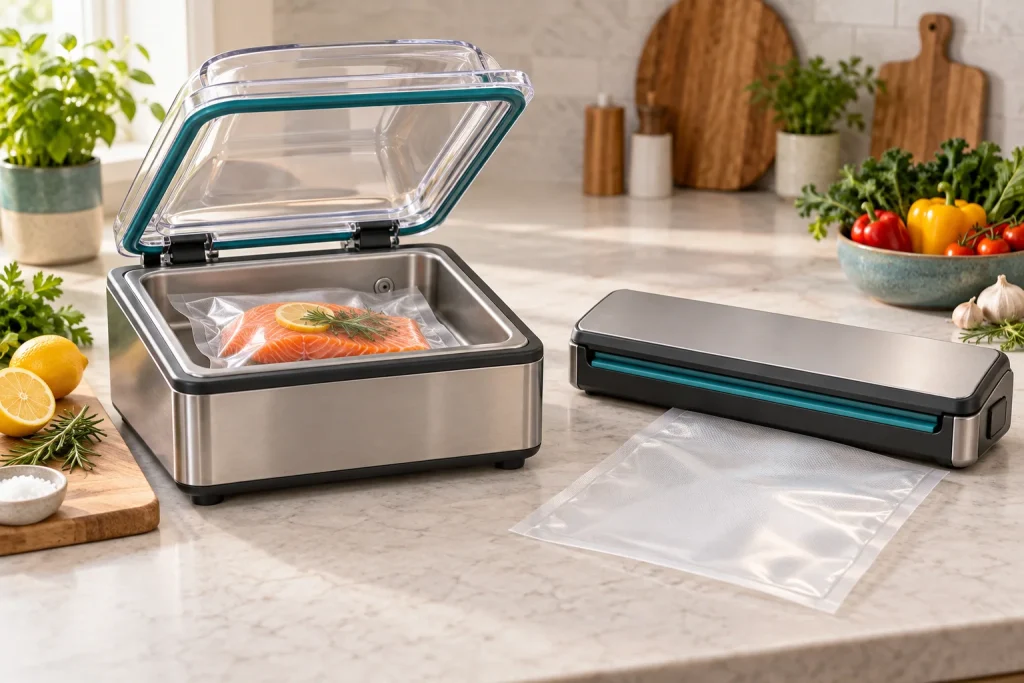
Choosing between a chamber vacuum sealer and an external vacuum sealer starts with what you package. A chamber machine is worth considering when your normal portions fit inside it and wet-food packaging is a recurring task. An external sealer remains a practical choice when you need flexible bag lengths, occasional use or a machine that is easy to put away.
Neither design wins every job. A compact chamber can be the wrong upgrade for a person sealing long fish fillets. A long external sealer can still be frustrating for someone regularly packaging soup. Compare your actual packages, working space and complete workflow before comparing motor specifications.
The practical differences at a glance
| Decision | Chamber machine | External suction machine |
|---|---|---|
| Package placement | The filled package normally goes inside a closed chamber | The bag opening goes into the machine while the food stays outside |
| Size constraint | Chamber shape, seal-bar width and loaded-pouch fit | Seal-bar width and the manufacturer’s bag-handling requirements |
| Liquids | A central reason to investigate chamber packaging; model limits still apply | Requires model-approved wet-food handling; liquid can enter the suction area |
| Bags | Commonly uses smooth chamber pouches | Commonly requires textured bags that preserve an air path |
| Working space | Needs room for the machine, open lid and loading | Needs room for the machine and the supported package in front |
| Ownership choice | Compare maintenance, consumables, placement and workload | Compare the same factors without assuming its lower purchase cost settles the decision |
Anova’s chamber explanation describes a cycle that reduces pressure around the package as well as inside it. The pouch is sealed before the chamber returns to atmospheric pressure. In an external machine, the suction path is through the bag opening. This difference explains why pouch construction and liquid handling are important purchasing questions.
Start with three real packages
Make a list of three things you package often, not three things a product photograph makes look appealing. Record the food, intended portion, bag size and whether the food is dry, wet or liquid.
A useful shortlist might include two chicken portions, a single meal of stew and a long piece of fish. Those jobs can point in different directions. The stew encourages investigation of chamber equipment; the fish may need more usable bag length than a small chamber offers.
If your largest portion is rare, consider whether dividing it is acceptable. Dividing a family-sized roast solely to fit the machine may defeat your reason for buying it. Dividing leftovers into the portions you already eat is a different decision.
Use our chamber-sealer size guide to check the filled package. An empty pouch fitting diagonally in a product photograph does not establish that a bulky meal will fit with its opening correctly positioned.
When a chamber sealer makes sense
You repeatedly package liquids or moist food
A chamber machine deserves attention if soup, sauces and foods with liquid are normal work rather than occasional exceptions. The relevant benefit is a more suitable packaging process, not permission to fill every pouch to the top.
You still need model-approved loading, a clean sealing area and control over bubbling. Our guide to vacuum sealing liquids addresses operation separately from machine selection.
Do not buy a larger chamber solely because the listing shows a bowl of soup. Check how the pouch is supported, whether its mouth sits above the liquid and how much room the loaded package needs.
Your ordinary portions fit its usable envelope
A chamber can be convenient when your normal bags sit naturally in it. That is more useful than a large advertised capacity that requires awkward folding or different meal portions.
Compare chamber depth, floor shape, seal-bar position and lid clearance. A wider bar does not necessarily provide a longer package. Capacity should be a drawing or physical fit check, not just a number of quarts in a headline.
You can give it a realistic home
Decide where it will stand during use. Include the open lid, outlet access, any ventilation clearance and a place for filled and finished bags. A machine that must be lifted from a low cupboard before every session has an ownership cost that will never appear in a bag-price comparison.
If you can leave it set up, a heavier machine may be manageable. If it must move frequently, weigh that inconvenience against the extra capacity you would actually use.
When an external sealer is the better choice
Long packages matter more than chamber depth
An external sealer can accommodate a package extending beyond its body, subject to its instructions and seal width. That can be useful for long foods or custom-length portions. It does not mean unlimited package size: the mouth still has to fit and the food needs support.
A chamber machine’s accessory hose is not automatic proof that it can vacuum an oversized bag outside the chamber. Canister evacuation and external bag sealing are separate functions. Check the exact model before relying on either.
You package food infrequently
For occasional dry-food or freezer-portion work, the additional equipment may solve a problem you do not have. Calculate the annual number of successful packages and the inconvenience of your current process before estimating savings.
An inexpensive machine is not necessarily good value if it cannot do your regular job. Equally, an expensive chamber is not justified by lower pouch cost when the annual bag count is small.
You need storage flexibility
Measure the available cupboard and your lifting route. Consider whether the machine can be stored in the orientation you plan to use. Do not assume an oil-pump machine can travel on its side simply because that makes it fit a shelf.
Compare ownership costs without promising payback
Use this structure for each candidate:
Annual cost = annualized purchase cost + consumables + planned maintenance + electricity + failed-package costs.
The useful comparison depends on your assumptions. If you assign a five-year useful life, that is a modeling choice, not evidence the machine will last five years. If you estimate failed bags, label the estimate and replace it with your own log later.
Compare bags with equivalent useful dimensions. A large roll section and a small precut chamber pouch are not interchangeable units merely because both hold food. Include the bottom seal and offcuts when measuring roll consumption.
Our ownership-cost worksheet explains this calculation. Bag savings can support a purchase, but should not override fit, handling or reliability evidence.
Ask about the whole batch
A quoted vacuum interval is only one part of packaging time. You also fill, load, seal, vent, unload, inspect and clean. Required pauses can matter more than a small difference in pumping speed.
Ask the seller for the exact manual’s session limit, rest requirement and intended use. Compare those answers with your normal batch. Avoid interpreting “commercial grade” as a documented number of bags per hour.
Pump type is another ownership question. If an oil-service schedule would be ignored in your kitchen, include that constraint honestly. If larger batches justify a serviceable machine and you can maintain it, consider suitable oil-pump models without assuming every one outperforms every dry-pump design.
Packaging and food safety are different decisions
A tight package does not make perishable food safe on a pantry shelf. USDA guidance states that vacuum-packaged perishable meat still needs refrigerated or frozen storage. Choose equipment for packaging, then follow appropriate food handling and preservation guidance independently.
Questions before you buy
Should a FoodSaver owner automatically upgrade?
No. Identify the specific limitation first: liquids, consumable costs, size, workload or maintenance. An upgrade that does not remove that limitation may add expense and counter clutter.
Can one machine do every package?
Possibly for a narrow household routine, but do not assume it. Check your largest package and your most difficult wet-food job. Some households may sensibly retain an external sealer alongside a chamber machine.
Does a stronger vacuum always mean a better result?
No. Food texture, package construction, settings and seal integrity all matter. More aggressive evacuation is not automatically suitable for delicate food, and an impressive pressure figure does not establish a reliable finished seal.
Make the choice from the job outward
Choose the equipment type that fits your routine, then compare specific models. Investigate a chamber machine when wet-food work, compatible portion sizes and a suitable workspace align. Keep an external machine in consideration when long packages, storage and occasional use dominate.
Your next useful step is to measure the three packages you listed and compare them with the compact chamber-sealer shortlist. If none fits naturally, revise the shortlist before spending money.
Sources
About the author
Seal Routine
Seal Routine helps home users choose chamber vacuum sealers, find compatible pouches and build a practical sealing routine. Our guides cover buying decisions, model comparisons, setup, maintenance and everyday ownership.