
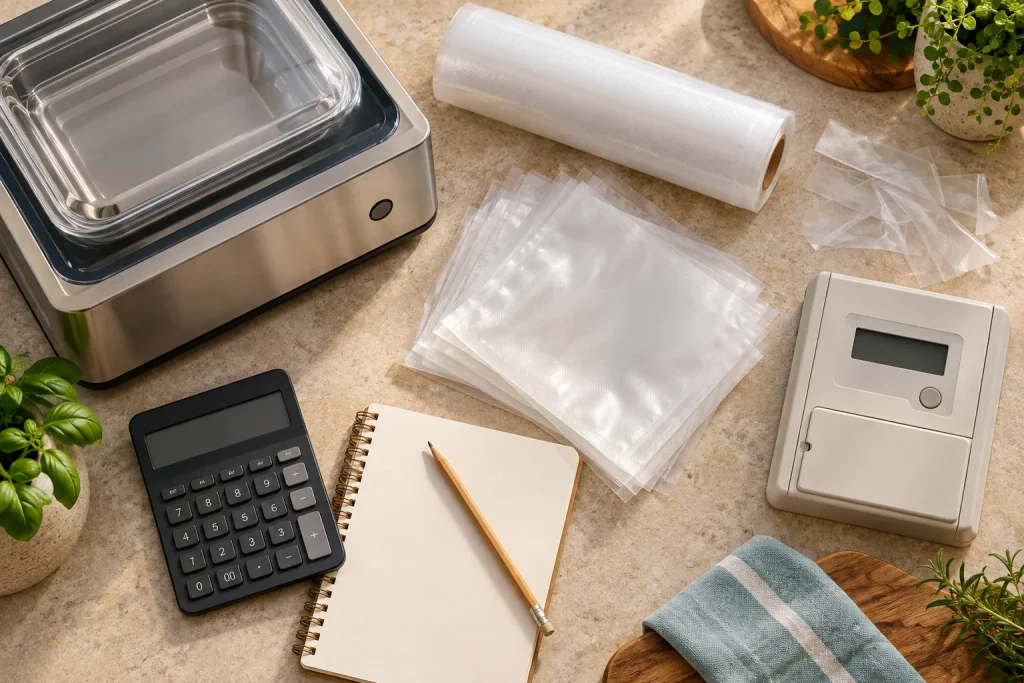
Comparing chamber vacuum sealer bag cost vs FoodSaver-style packaging is useful only when you compare equivalent successful packages. A cheaper empty pouch does not settle the cost of the machine, maintenance, discarded material or the portions you actually want to store.
Build the calculation from your annual use. The examples below are illustrative inputs, not current prices, tested failure rates or promises of equipment life. Replace them with your own receipts, bag dimensions and operating log.
Begin with the package, not the pack
Define a standard job: a particular portion, filled shape and intended use. Identify a compatible chamber pouch and a compatible external bag that both do that job. Compare their finished useful dimensions, not just their names.
For rolls, include the length needed for the bottom seal, the clean opening and any offcut. For precut pouches, include the part of the pack that is too large or too small for your normal use.
The bag construction must suit the machine before cost enters the decision. See smooth versus embossed bags if you have not confirmed that requirement.
A worksheet you can copy
| Input | Candidate A | Candidate B |
|---|---|---|
| Delivered equipment cost | ___ | ___ |
| Assumed useful years for modeling | ___ | ___ |
| Annual successful packages | ___ | ___ |
| Equivalent material cost per attempt | ___ | ___ |
| Assumed failed-attempt proportion | ___ | ___ |
| Annual planned maintenance and consumables | ___ | ___ |
| Measured or assumed electricity per session | ___ | ___ |
| Annual sessions | ___ | ___ |
| Your electricity price | ___ | ___ |
Keep assumptions visibly separate from measurements. A spreadsheet containing precise decimals is not more reliable than the inputs entered into it.
Calculate material cost per successful package
For precut pouches:
Material cost per attempt = delivered pack cost ÷ usable pouch count.
If a hypothetical 200-pouch pack costs $40 delivered and every pouch is useful, the material cost is $0.20 per attempt. If only 150 fit your normal jobs, either assign the remaining 50 to other genuine uses or recognize the cost of buying a poorly matched pack.
To incorporate failed attempts in a simple model:
Material cost per successful package = material cost per attempt ÷ (1 − failed-attempt proportion).
At an assumed 5% failure proportion, a $0.20 pouch costs about $0.211 per successful package in material. That is an arithmetic illustration. It does not claim a 5% failure rate for any machine.
This simple formula assumes attempts have comparable material costs. If failures use different replacement bags or create significant food loss, track those costs separately. Do not assign unsafe food a recoverable value merely because it can be repackaged.
Calculate roll consumption fairly
Measure the length of roll consumed for the same finished portion. Include both sealing allowances and waste rather than comparing only the length surrounding the food.
If a hypothetical roll costs $18 for 50 feet and an equivalent package consumes 15 inches, its material cost is $18 ÷ 600 × 15 = $0.45. Replace these hypothetical inputs with your current delivered prices.
Change the consumed length and the result changes. This is why a price-per-foot comparison can mislead when one machine or portion requires more material. Our rolls-versus-precut guide focuses on this part of the worksheet.
Include equipment without inventing longevity
A simple annualized equipment cost is:
Annualized equipment cost = delivered equipment cost ÷ assumed useful years.
Choosing five years for the worksheet does not establish a five-year lifespan or a warranty. Use several scenarios, such as shorter and longer ownership, and see whether the purchase still makes sense.
If you already own a functioning external machine, distinguish the upgrade decision from a comparison between two new purchases. Its historical purchase cost is already spent. What matters now may be the extra money needed to upgrade, avoidable future costs and any real limitation the existing unit has.
A new buyer comparing two machines faces a different calculation. Do not mix those situations in a single payback claim.
A transparent break-even example
Suppose, purely for illustration, a new chamber setup costs $300 more than the alternative and saves $0.12 per equivalent successful package before other costs.
Break-even packages = $300 ÷ $0.12 = 2,500 packages.
At 500 packages per year, that is five years before allowing for differences in maintenance, electricity, failures or replacement. At 100 packages per year, it is 25 years. Neither result predicts that the equipment will last that long.
If the actual saving falls to $0.06, the break-even count doubles. If the more expensive machine also requires a cart or new work surface, include that expense. If liquids make a task practical that the old setup could not handle, describe that benefit separately rather than inventing a dollar value for it.
Electricity: measure a session when possible
A nameplate wattage is not automatically the average draw throughout a complete cycle. Pumping, heating, venting, standby and pauses can have different demands.
For a clearly labeled estimate, energy in kilowatt-hours equals average watts × operating hours ÷ 1,000. An assumed 300-watt average over a one-minute operation gives 0.005 kWh. At an assumed $0.20 per kWh, that is $0.001. Those figures demonstrate units and arithmetic, not the electricity cost of a named sealer.
A suitably rated plug-in energy meter can provide more useful session data where the machine and outlet arrangement permit it. Record the number of successful packages, setup time and standby included. Do not compare a whole-session reading for one machine with a pump-only estimate for another.
Maintenance includes more than oil
Oil-pump models may require model-specific oil and service. Dry-pump designs avoid that task, but sealing consumables, gaskets and cleaning still exist.
Use the exact maintenance schedule and parts costs for each candidate. Do not assume a universal change interval or charge every model for the same maintenance kit. Distinguish required service from optional spare parts you buy for convenience.
Our pump comparison and parts compatibility guide help identify those inputs.
Keep time separate unless you value it explicitly
Record filling, loading, the full machine cycle, inspection, required pauses and cleanup. A short vacuum interval does not describe a complete working session.
You may assign your own hourly value to active labor, but label it as a personal choice. Do not count unattended machine time and active work as identical without explaining the assumption. For many households, convenience is better described directly than disguised as guaranteed cash savings.
The duty-cycle guide explains why session limits can alter throughput.
Run three sensitivities before deciding
Recalculate with lower annual usage, a smaller bag saving and a shorter useful-life assumption. If the purchase only appears attractive under the most favorable combination, the cost case is fragile.
Also test a scenario where there is no measurable reduction in food waste. Packaging may help your routine, but buying a machine does not prove that previously discarded food will become safe, edible or wanted.
Keep a monthly log after purchase. Replace assumed bag consumption and failure rates with observations, then update the worksheet. Use the log to improve filling or material selection rather than merely defending the purchase.
Questions about sealer economics
Do chamber bags always make a chamber machine cheaper?
No. A lower compatible-pouch cost can be outweighed by low usage, equipment cost or a poor fit for your normal packages. Compare the whole scenario.
Should I include a warranty as extra useful life?
No. Warranty coverage and actual equipment life are different. Model useful life explicitly and check warranty terms separately.
Is the smallest cost per seal the best choice?
Only if the packages meet the job and the assumptions are sound. A low calculated figure is not useful when the machine cannot fit your food or support the required workload.
Use the worksheet to challenge the purchase
The calculation should reveal which inputs drive the decision. If annual use and compatible bag savings support the expense across reasonable scenarios, the cost case becomes clearer. If not, the purchase may still solve a practical problem, but it should be justified by that problem rather than a fictional payback promise.
Try the cost-per-package calculator
Replace every example input with your own records. The calculator compares packaging operating costs; it does not estimate food savings or product performance.
About the author
Seal Routine
Seal Routine helps home users choose chamber vacuum sealers, find compatible pouches and build a practical sealing routine. Our guides cover buying decisions, model comparisons, setup, maintenance and everyday ownership.