
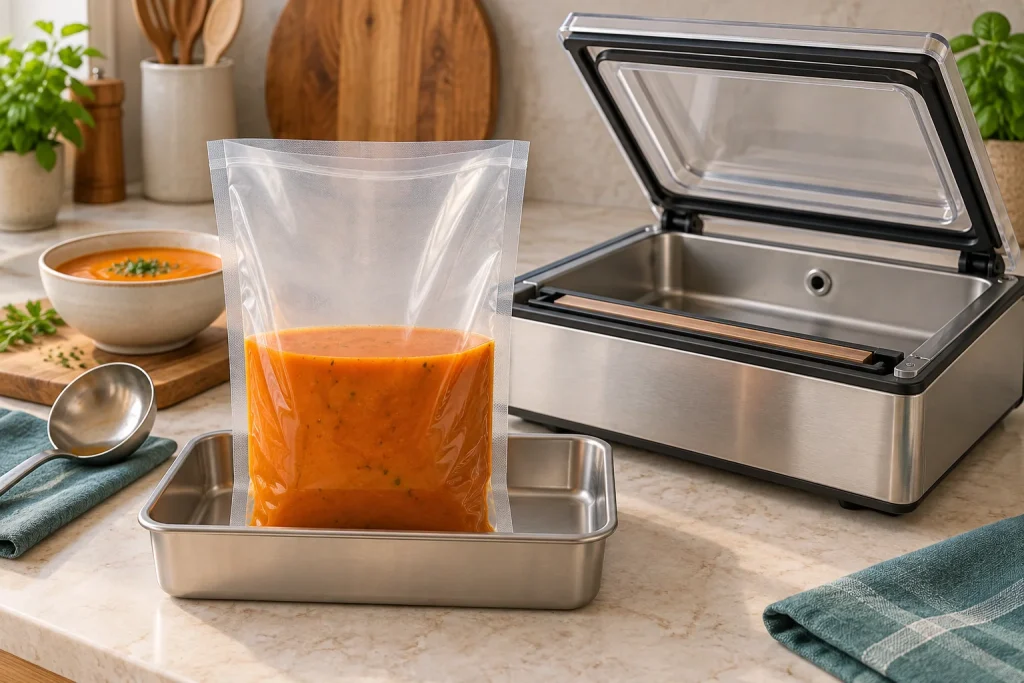
To vacuum seal liquids in a chamber sealer, use a machine-approved pouch, keep the sealing area clean, follow the model’s fill and temperature guidance, and position the opening correctly above the load. Watch the cycle and use the documented stop or seal control if liquid approaches the sealing area.
Chamber equipment makes liquid packaging possible in a way that differs from external suction packaging. It does not eliminate overfilling, bubbling, contaminated seals or the need to refrigerate perishable food.
Why liquid can bubble under vacuum
Reducing pressure lowers the temperature at which water boils. Bubbles can also come from air leaving the food. Bubbling under vacuum is therefore not proof that soup is hot, cooked, sterilized or safe for pantry storage.
Leybold’s vacuum-cooling explanation describes the link between reduced pressure and evaporation. That physical principle explains the need to control the package, but it is not an instruction to use a household sealer as a food-cooling appliance.
Use the sealer for the food and process its manufacturer permits. Do not use a dry/cool or infusion program as a substitute for food-safety guidance.
Prepare before opening the pouch
Read the exact model’s liquid instructions, including any food-temperature restriction and the behavior of its stop controls. Confirm the intended pouch’s material, opening width and filled dimensions.
Prepare a stable filling station, utensils, labels and an appropriate cold-storage destination. Keep raw-food handling separate from clean finished packages. Organize a manageable quantity rather than filling many perishable bags and leaving them waiting while you learn the machine.
Follow authoritative guidance for cooling and storing the food before packaging. Simply leaving a large hot pot on the counter until it seems convenient to seal is not a safe cooling method. FoodSafety.gov explains prompt refrigeration and time limits for perishable foods.
Use a conservative, model-approved fill
Follow the maker’s limit rather than choosing a universal percentage for every chamber. For the USV20 specifically, Avid Armor’s liquid guidance says to fill the pouch no more than halfway because liquid shifts toward the opening when the bag is laid down.
That is a USV20 instruction, not proof that another machine supports the same arrangement. The important general questions are whether the load sits stably, where the liquid moves as the package lies down and whether the mouth remains in the correct position.
If your meal cannot fit within the supported arrangement, choose a different pouch, portion or machine. Holding a bag precariously in place while closing the lid is not a good workaround.
Keep the opening clean
Use a filling method that avoids coating the sealing area with sauce, oil or food particles. A suitable pouch stand can help support the bag, but it must suit the bag and be kept out of the machine unless approved for that use.
Inspect the mouth before loading. If it is contaminated, follow the bag and machine guidance for preparing a clean seal area or use a fresh pouch. Do not assume increasing seal time will reliably heat through food residue.
Leave the clean space required by the instructions. An overfilled bag may have enough room to close mechanically while leaving no useful buffer for movement and bubbling.
Load in the documented orientation
Place the filled pouch where the manual shows, with its opening across the seal bar and any clamp used correctly. Make sure the bag is not trapped beneath the lid gasket or folded in a way that closes the air path.
Verify that the contents do not interfere with the lid or sealing mechanism. Keep the mouth supported as intended. A smaller liquid portion may behave differently from a larger one, so do not assume the same visual arrangement remains suitable as fill increases.
If you need a fit check, use our chamber sizing guide. The maximum empty pouch size is not a maximum soup-serving claim.
Watch the first cycles
Start from the model’s approved setting and observe the liquid through the lid. Know which control stops the whole cycle and which advances to sealing; these actions may differ and are not necessarily instantaneous.
If liquid advances toward the seal assembly, follow the manufacturer’s approved response. Do not force the lid open against vacuum or reach into a running machine. A failed first trial is a reason to reassess fill, placement and settings, not to repeat the same overfilled load.
Record the pouch, portion and selected settings. Change one variable at a time within the permitted range. The goal is a controlled process that you understand, not the strongest possible vacuum on every food.
Inspect the finished package
Wait for the documented cycle completion and venting before opening. Inspect the sealing area for folds, contamination, gaps or damage. Check for liquid outside the pouch and clean the machine as required.
A visibly tight package is useful packaging evidence, but it does not establish the food’s safety or a particular storage life. Label the food and date, and move it into the appropriate refrigerated or frozen storage without unnecessary delay.
Clemson Extension’s vacuum-packaging guidance separates potential quality benefits from the need for safe storage. Do not invent a refrigerated shelf-life extension from the appearance of a seal.
Troubleshoot the problem you actually see
| Observation | What to investigate first |
|---|---|
| Liquid reaches the pouch mouth | Fill quantity, orientation, movement and approved stop response |
| Seal has food or moisture across it | Filling method and clean sealing area |
| Pouch moves away from the bar | Loading, clamp position and pinched airflow |
| Package looks loose immediately | Correct cycle, placement and machine condition |
| Package loosens later | Seal damage, puncture, food changes and storage handling |
| Liquid enters the machine beyond a surface spill | Stop use and obtain model-specific service guidance |
The troubleshooting hub goes deeper into these distinctions. A liquid spill is not automatically a pump failure, and a completed cycle does not prove nothing entered the internal path.
What to do after a spill
Follow the exact manufacturer’s cleanup procedure. Avid Armor publishes a USV20-specific spill response; that is not a universal recipe for other pumps or chambers.
Turn off, isolate and allow cooling as the model directs before cleaning. Do not rinse the appliance, inject cleaning fluid into a port or run an improvised solvent cycle. If you suspect internal contamination, explain the food, approximate amount and symptoms to support before further operation.
Our wet-food cleaning guide helps distinguish removable parts, wipe-clean surfaces and service questions.
Common questions
Can I vacuum seal warm soup?
Chill it before chamber packaging. Reduced pressure lowers the boiling point, so warm soup can foam and move toward the seal before evacuation finishes. Cool cooked food promptly in shallow containers or an appropriate cold-water or ice-water arrangement; do not leave a stockpot on the counter waiting to cool. Then package manageable chilled portions.
Does bubbling mean the soup is being pasteurized?
No. Reducing pressure lowers the boiling point, so visible bubbling can happen without the heat exposure required for pasteurization. The machine is evacuating a package, not providing a validated cooking process. Keep the original cooking, cooling and storage requirements for the food.
Can I seal liquids outside the chamber?
The USV20’s external-bag method excludes liquids. Keep free liquid inside a supported chamber-pouch arrangement; ordinary external suction can pull it toward the intake. An accessory hose for a compatible canister is a separate setup and does not authorize liquid-filled outside bags.
Can I fill a bag more if I use a stronger setting?
No. A stronger or longer cycle cannot create the empty neck or lower liquid level that an overfilled pouch lacks. On USV20, the liquid limit is no more than half full. Reduce the portion or use a suitable different package layout instead of trying to overcome movement with more vacuum.
Build a repeatable routine
Choose the correct pouch, respect the model’s fill guidance, keep the mouth clean and monitor the first cycles. Record what you actually did and inspect the result. If liquids are your main reason for buying, compare the liquid-focused equipment guide after completing these loading and safety checks.