
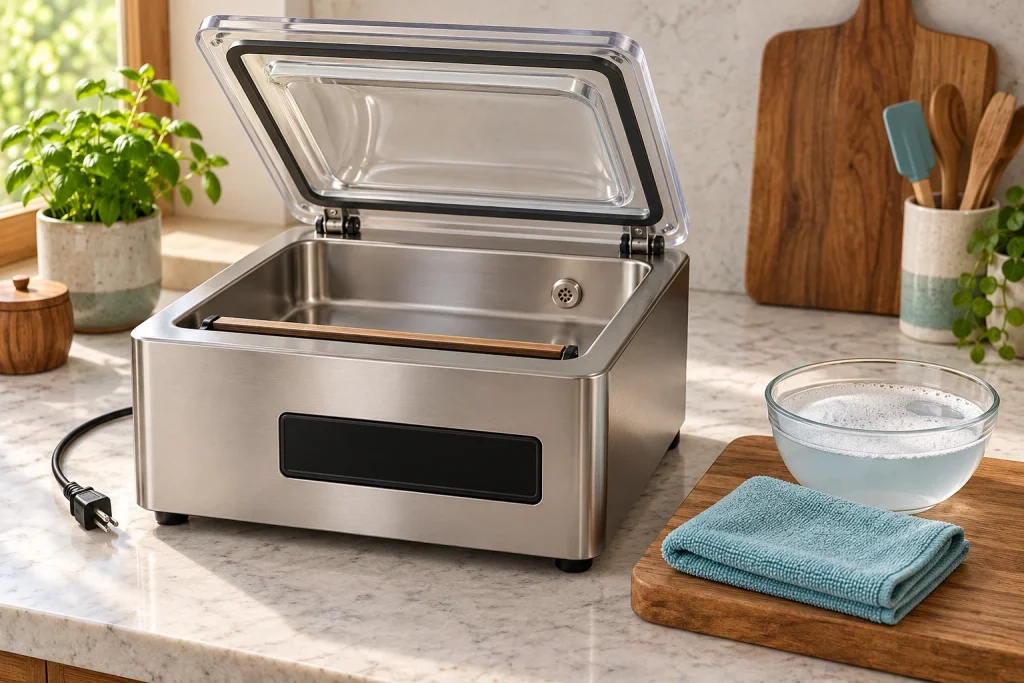
How to clean a chamber vacuum sealer depends on the exact model and where the food went. Ordinary residue on an accessible surface is different from liquid entering a port or internal mechanism. Start with the manufacturer’s cleaning instructions, approved isolation procedure and component rules.
Do not assume the whole machine is washable because one brand advertises a removable tray. A removable seal bar also is not automatically dishwasher-safe.
Identify what needs cleaning
| Area | Question to answer before cleaning |
|---|---|
| Chamber floor and walls | Which cleaner and cloth method does the manual allow? |
| Seal bar and protective surface | Must it cool, and is removal or wet cleaning permitted? |
| Lid gasket and groove | Is the gasket removable, and how is it reseated? |
| Removable tray or insert | Is rinsing or dishwasher use expressly approved? |
| Exterior controls | Which wiping method avoids fluid entry? |
| Port, tubing or pump path | Is manufacturer support needed before another cycle? |
Locate those answers before dismantling anything. The object is to remove residue without damaging sealing surfaces or carrying fluid into parts that should stay dry.
Prepare the area and isolate correctly
Finish or stop the cycle using the documented controls. Wait for the chamber to vent and open normally. Then turn off, unplug and allow hot parts to cool as the model directs before cleaning or approved removal.
Do not force a lid against vacuum or unplug a running machine as a routine stop method. Anova’s safety documentation distinguishes normal operation from unplugging before cleaning and warns against immersing electrical components.
Move food into appropriate storage and separate used utensils from clean packages. Dispose of residue and prepare the approved cleaning materials before touching the sealing assembly.
Remove ordinary residue gently
Use the model’s approved cloth and cleaner. Avoid forcing fluid into openings, joints or controls. Do not scrape a protective sealing surface with a sharp tool to remove a stubborn mark.
Pay attention to the pouch loading area and the places where food may have contacted a clamp or insert. A clean-looking chamber floor does not establish that the seal interface is free of residue.
Work from accessible surfaces according to the manual, then dry them as directed. If residue cannot be removed by the permitted method, ask support before using a solvent or abrasive.
Treat cleaning and sanitizing as different steps
Cleaning removes soil. Any food-contact sanitizing process needs a suitable product, concentration, contact time and material compatibility. Follow both the appliance instructions and the cleaning product’s label; do not invent a universal bleach or vinegar recipe for all chambers.
If instructions conflict, resolve the conflict before applying the chemical. Stainless-looking exterior panels do not establish the material of the chamber, gasket, lid or internal components.
Use appropriate food-handling guidance for the work area as well. FoodSafety.gov addresses preventing cross-contamination; the packaging cycle does not clean the utensils or counter.
Check removable parts individually
Vesta’s V513/V553 documentation specifically advertises removable cleaning components. LEM’s 1745 information identifies an approved cleaning treatment for its riser insert. Those statements do not make other components, or another brand’s insert, suitable for the same treatment.
Identify the part number and the permitted method. Let washed parts dry as instructed before refitting. Reinstall a gasket or sealing assembly only in its correct position and do not operate with a protective part missing.
If a part is distorted or damaged, cleaning is not a substitute for the appropriate replacement. Our parts guide helps distinguish a gasket from a sealing pad, wire and protective tape.
If liquid spilled inside the chamber
Record the food, approximate quantity and where it traveled. A surface spill confined to a removable tray may have a different response from liquid near an inlet or moving sealing mechanism.
Avid Armor publishes a USV20-specific spill procedure. It includes treatment of particular components and a manufacturer-directed cycle. Use that exact guidance only for the applicable model, and ask support if the current manual or your unit differs.
Do not transfer a vinegar-vapor or conditioning routine from one model to another. The permitted process depends on the pump and internal design. An odor disappearing does not prove an internal path has been restored or sanitized.
If liquid reached a port, controls or an uncertain internal area, stop and contact the manufacturer before further operation. Describe the spill rather than calling it simply a cleaning issue.
Inspect the seal interface before restarting
With the unit isolated as directed, inspect accessible protective tape, pad and gasket for residue, displacement or damage. Follow the manual’s owner-check boundary.
Once everything is correctly assembled and dry, use the approved startup procedure. If a simple permitted check shows abnormal behavior, stop. Do not package a batch of food merely to see whether the issue clears itself.
A new sealing fault after cleaning can follow a displaced component as well as a damaged one. Our troubleshooting hub helps organize the symptom before you order parts.
Prevent avoidable spills and residue
Use a suitable pouch size and filling support. Keep the mouth clean before loading and do not crowd the sealing area. For liquids, follow the exact fill and placement limits rather than relying on a tighter lid to hold an unstable bag.
Maintain a clean-to-dirty work pattern: fill, inspect the mouth, seal, inspect the result and move it to storage. Keep raw-food residue from handles and controls where practical.
If the same area gets dirty every session, revise the filling setup. Repeated cleanup is a useful signal that the pouch or loading arrangement may not suit the job.
Questions about cleaning
Can I wash the seal bar under the tap?
Only when the exact manufacturer’s instructions approve it for that component. “Removable” does not mean “washable.”
Can I run water through the vacuum port?
Do not do so unless the manufacturer gives an explicit procedure for the exact model. Improvised flushing can turn residue into internal damage.
Is a damp cloth enough after raw meat?
Follow the appliance’s approved cleaning and appropriate food-contact hygiene process. A generic wiping suggestion cannot establish sanitation for every material and use.
Should the lid stay open during storage?
Use the model’s storage instructions after all parts have dried. Lid and gasket storage positions differ; do not impose one rule on every machine.
Clean the machine you own
Identify the affected surface, isolate and cool the unit correctly, and use the approved process for each part. Escalate uncertain internal spills rather than experimenting. A careful cleaning routine protects both the next package and the equipment you rely on to make it.
Sources
- Anova: chamber sealer product documentation
- FoodSafety.gov: four steps to food safety
- Vesta: V513 and V553 specifications
- LEM: MaxVac Pro 1745 specifications
- Avid Armor: liquid spill in USV20
About the author
Seal Routine
Seal Routine helps home users choose chamber vacuum sealers, find compatible pouches and build a practical sealing routine. Our guides cover buying decisions, model comparisons, setup, maintenance and everyday ownership.