
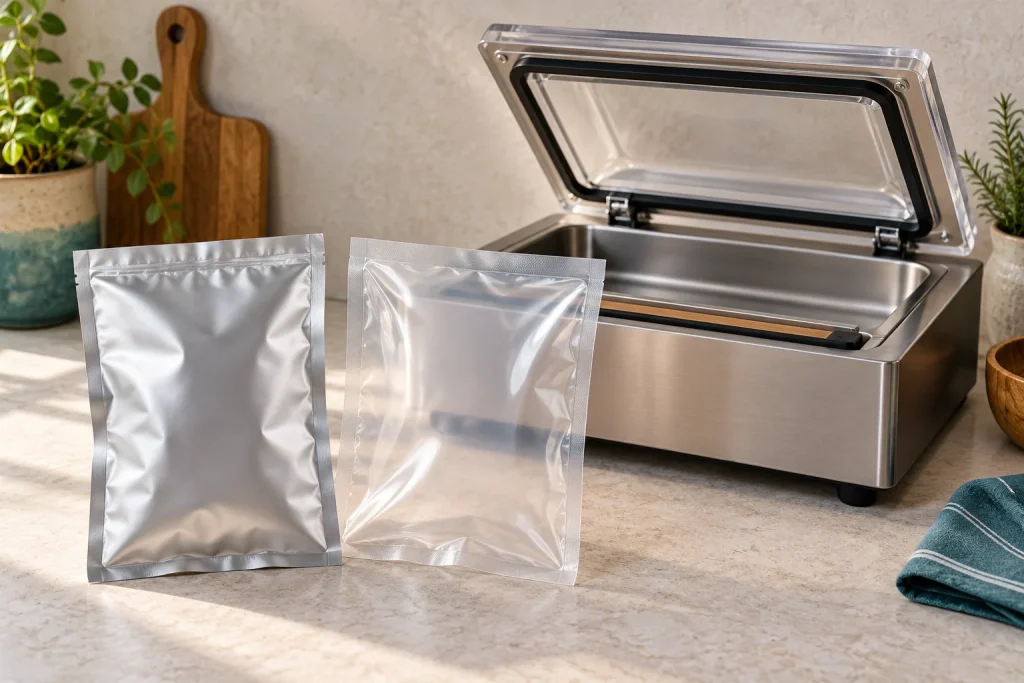
You can use some Mylar bags with some chamber vacuum sealers, but the phrase “Mylar bag” is not a complete compatibility specification. Verify the actual pouch construction, thickness, opening and intended machine before buying a case or selecting a hotter setting.
There are three separate questions: can the pouch be evacuated in the approved arrangement, can the machine make the required heat seal, and is that package appropriate for the intended food and storage process? A yes to one does not answer the others.
Why the label is insufficient
Products sold as Mylar bags can differ in laminate, sealant layer, thickness, gussets, zipper, surface and supplier instructions. A reflective appearance does not tell you how the heat-seal layer behaves.
Get the exact supplier record. Ask whether the pouch is intended for chamber vacuum packaging, what its dimensions mean and what sealing equipment or conditions are specified. If the seller can only repeat “food safe,” the machine-compatibility question remains unanswered.
Do not infer cooking approval or long-term shelf stability from the laminate name. Those require their own appropriate evidence.
A documented example: USV20
Avid Armor’s USV20 Mylar guidance recommends its own Mylar vacuum pouches, gives a 7–9 seal-time setting range and says other-brand bags should be no thicker than 7 mil. These are the maker’s model-specific instructions, checked on 30 October 2026.
They are not a universal seven-mil rule for chamber sealers. Nor do they mean every bag below that thickness has a suitable laminate, fits the machine or produces an acceptable seal at the same selection.
Use the current instructions for your actual unit and material. If the bag supplier and machine maker provide different requirements, resolve the conflict before packaging food.
Check the opening and loaded fit
Confirm which edge opens and whether a zipper or gusset affects the space available for heat sealing. The mouth must lie across the sealing assembly as the machine requires, with a clean flat sealing area.
A bag whose outside width equals a published maximum may still be unsuitable because of a gusset, stiff fold or the way it wraps around the load. A broad specification such as “one gallon” does not resolve that geometry.
Use our pouch sizing guide for a filled-package check. Do not force an opaque pouch into a chamber arrangement you cannot inspect adequately.
Evacuation and heat sealing are different tests
A machine may close a seam without removing air as intended. Conversely, a pouch may evacuate while the selected sealing conditions fail to create a dependable closure.
Check the full approved cycle. Do not assume an external suction machine can evacuate a smooth laminate simply because its heat bar can seal that material. The required air path may differ.
Our smooth-versus-embossed guide explains the evacuation issue. Treat Mylar compatibility as an additional material question rather than a replacement for it.
Make an appropriate material trial
Start with a small quantity from the intended supplier and the maker’s permitted settings. Inspect an empty or otherwise approved trial package before committing a valuable food batch. Keep the supplier record and the machine settings with the result.
Look for folds, incomplete ends, distortion or a seam the maker would reject. Do not treat a shiny straight line as a laboratory seal-strength measurement.
If a new material needs a setting beyond the machine’s permitted range, choose a suitable material or approved sealing equipment. Repeatedly maximizing heat is not a sound compatibility strategy.
Plan the sealing area before filling
Keep food, powder and moisture away from the mouth. A thick laminate does not eliminate the effect of contamination. If a zipper is present, follow the supplier’s directions for the location of any heat seal rather than improvising around it.
Allow the clean space the instructions require. An overfilled pouch can leave insufficient room for a flat seam and make correct chamber placement difficult.
For powder-filled bags, also read the machine’s powder guidance. Preventing material from entering the vacuum path is a separate issue from whether the laminate can be sealed.
What Mylar compatibility does not prove
It does not establish a food’s water activity, a microbial kill step, a safe room-temperature storage period or cooking suitability. It also does not establish that an oxygen absorber or desiccant is appropriate for every food.
Oregon State Extension explains that vacuum packaging does not replace the preservation or cold-storage requirements of perishable foods. Use authoritative guidance for the specific food rather than treating an opaque barrier package as a preservation process.
Avoid universal storage charts that assign years of life solely by bag type. The food, preparation, environment and validated process matter. Our food-safety article addresses those distinctions.
Compare packs after compatibility
Once the machine and material are matched, compare useful dimensions, quantity and delivered cost. A large pack is poor value when its opening does not fit or its size creates avoidable waste.
Check that a later reorder is the same specified laminate rather than a similar photograph. Product variations and thickness descriptions can change. Retain the item number, supplier and date.
The chamber-pouch buying guide includes material and fit considerations. It does not treat every reflective bag as an interchangeable alternative to a standard chamber pouch.
Questions buyers ask
Can every seven-mil bag work in the USV20?
No. Thickness is only one condition. The laminate must seal with the appliance, the mouth must fit the bar, and the filled pouch must fit the chamber. A zipper or foil layer can also change the closure requirement. Match those features before interpreting a maximum-thickness claim as universal compatibility.
Does the zipper make heat sealing unnecessary?
Not when the pouch’s barrier closure depends on a heat seal above the zipper. A zipper is convenient for access but can retain particles or provide a different closure from the intended storage seam. Choose a pouch with a clearly specified closure method and enough clean film above the zipper for that seam.
Can I microwave or boil a Mylar pouch?
Not from the Mylar name alone. Some laminates contain metal and have heating restrictions, while others carry specific cooking ratings. Check the intended heating method, temperature and duration on the actual pack. If that use is not supported, remove the food to a suitable vessel instead of heating the storage pouch.
Should I use the longest seal time for extra security?
No. Excess heat can distort or burn through the laminate, creating a weaker package. Start from a suitable material setting and examine a clean seam for gaps, wrinkles or melted areas. A damaged heat seal is a reason to correct the setting or material, not simply apply still more heat.
Make the decision from the specification
Identify the actual pouch, match it to the exact machine, verify the loaded arrangement and follow the approved sealing process. Keep food-preservation decisions separate. That is a more useful test than asking whether a sealer works with “Mylar” in general.