
Amazon links are affiliate links. As an Amazon Associate I earn from qualifying purchases. If you buy through these links, we may earn a commission at no extra cost to you. Affiliate disclosure.
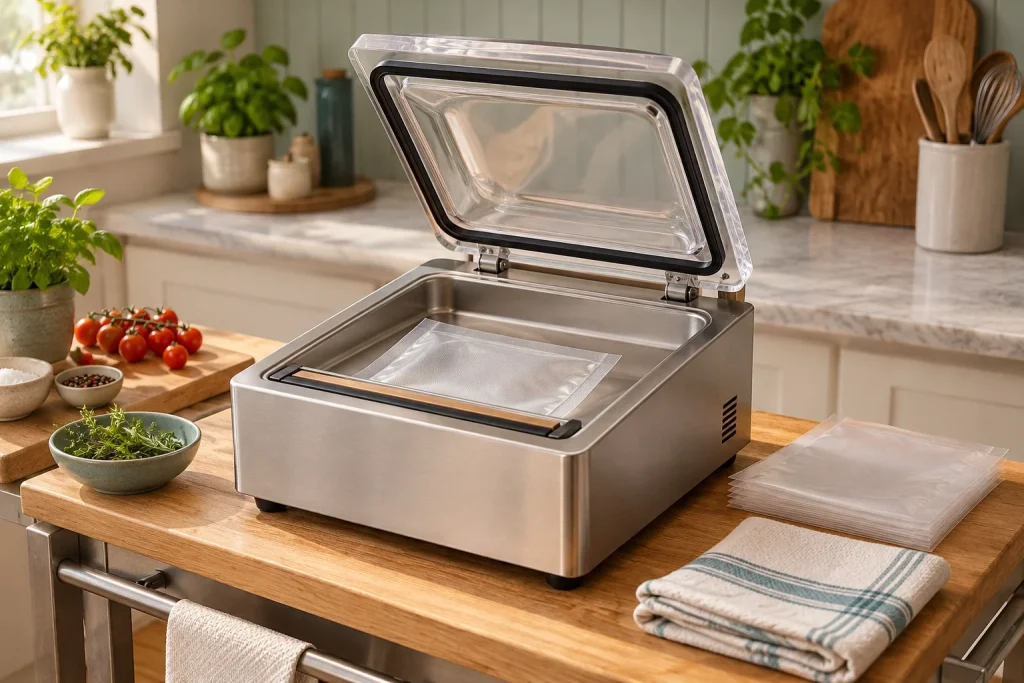
This Avid Armor USV1 review examines a small-format chamber candidate for households where storage and handling matter as much as packaging features. Its buying case is strongest when the supported pouch envelope fits your normal portions and preset controls suit your routine.
The manufacturer-stated starting point
| Detail | USV1 record |
|---|---|
| Closed body | 12 × 12 × 6.25 inches |
| Chamber | 10.5 × 10 × 2.25 inches |
| Supported maximum pouch | 10 × 10 inches |
| Controls | Three vacuum levels and three seal settings |
| Weight | 13.05 pounds |
| Pump | Dry design |
Compare the exact model and bundle on Amazon. Confirm the selected seller, included items, warranty and delivery before ordering.
Source: USV1 product information. These are published specifications, not our measurements. The supported pouch dimensions should not be interpreted as a maximum solid-food block.
Small format is useful only if the package fits
A compact machine can be easier to place while still being the wrong size for your ordinary food. Check the thickest regular portion, the way the bag wraps around it and the clean mouth needed for sealing.
Do not begin with a manufacturer’s attractive food photograph. Begin with the portion you actually want to store. If every session requires dividing it differently, decide whether that change is acceptable before calling the capacity adequate.
The sizing worksheet provides the method. When fit is close, ask for an exact model demonstration rather than using the glass lid as a clearance test.
Preset controls and the document check
The current product table describes preset vacuum and seal levels. That may suit an owner who wants a small set of choices for familiar pouches.
Some support wording uses numerical timing language in a way that should be checked against the actual control revision. Do not borrow a seven-to-nine setting or another model’s instructions when the unit’s documented interface differs. Ask support to clarify the applicable process.
Check the current machine label when control descriptions differ between a general FAQ and a model page.
What this review can and cannot say about results
The documented features establish what to investigate. They do not establish that the machine seals more reliably than an external sealer, runs quietly or handles delicate foods without any compression.
The responsible buying judgment is therefore conditional: the USV1 may suit small portions and limited space if its instructions and supported workload match the job. That is different from a tested best compact award.
Bags and useful pack sizes
Use Avid Armor’s supported size list for the exact model. Choose a modest quantity of the dimensions you will actually use before buying a case or variety pack.
A pack containing longer sizes for another Ultra Series machine is not automatically a USV1 pack. Check opening orientation and loaded fit as well as nominal width.
If using existing material, obtain the model-specific compatibility guidance and material settings. Smooth versus textured construction, thickness and cooking conditions are separate questions. The bag compatibility guide explains that distinction.
Wet food and accessories
The USV1 support collection describes wet-food use and accessory functions. Follow the current exact-model loading, fill and control instructions rather than transferring a routine from USV20.
A small chamber does not remove liquid movement or bubbling. Plan a stable filled pouch with a clean opening and learn the approved stop response before use.
For canisters or jars, match the entire connection and container system. A port does not establish every adapter’s compatibility, and jar evacuation does not establish a validated preservation process.
Storage and lifting
The documented compact body gives the machine a reason to be investigated for a small kitchen. Measure the open lid, required clearances and the actual cupboard route before treating it as a convenient storage appliance.
We do not endorse one-handed lifting merely because a product description suggests portability. Choose a safe handling method for the actual weight, grip and location, following the maker’s instructions.
If the unit will remain on the counter, include loading and inspection space. If it moves after every session, that repeated task deserves weight in the decision.
Maintenance and ownership cost
The dry pump avoids pump-oil service, but cleaning and sealing consumables remain. Identify the correct gasket, seal pad and assembly before ordering replacements; do not assume parts fit across the entire brand.
Ask for the documented between-cycle and session requirements. A small household batch may suit the model, but an oil-free label does not establish continuous operation.
Use the ownership worksheet with your annual successful packages and compatible material. Do not assume a particular useful life or guaranteed food-waste saving to make the arithmetic attractive.
Alternatives to compare
The USV1-versus-USV20 guide is the relevant next step when a wider supported envelope or explicit timing might help. The compact-machine shortlist compares other layouts and interfaces.
If the actual requirement is long packages or a substantially larger batch, consider a different format rather than assuming the smallest chamber should stretch to the job.
Before ordering
Confirm the selected unit’s model, voltage, seller, included pouches and accessories, returns and warranty eligibility. A product remaining in a maker’s catalog does not verify current stock at another seller.
Save the matching manual and any clarification of the control wording. If the offered revision differs, do not attach these specifications automatically.
Questions buyers ask
Is USV1 enough for a family?
Family size is not a package dimension. Check the portions you intend to store and the supported loaded arrangement.
Is it a smaller USV20 with identical settings?
Do not assume that. The current product records describe different control approaches and pouch envelopes.
Have you confirmed how quiet it is?
There is no comparable decibel result here that establishes a quietest choice. Compare measurements taken at the same distance, setting and cycle stage.
Review conclusion
The USV1 deserves investigation when a small-format machine solves your storage problem without creating a package-fit problem. Match the actual controls and supported pouches, clarify document conflicts and verify the offer. Its value depends on that fit, not an untested promise that compact equipment can do every job.
About the author
James
James helps home users choose chamber vacuum sealers, find compatible pouches and build a practical sealing routine. Our guides cover buying decisions, model comparisons, setup, maintenance and everyday ownership.