
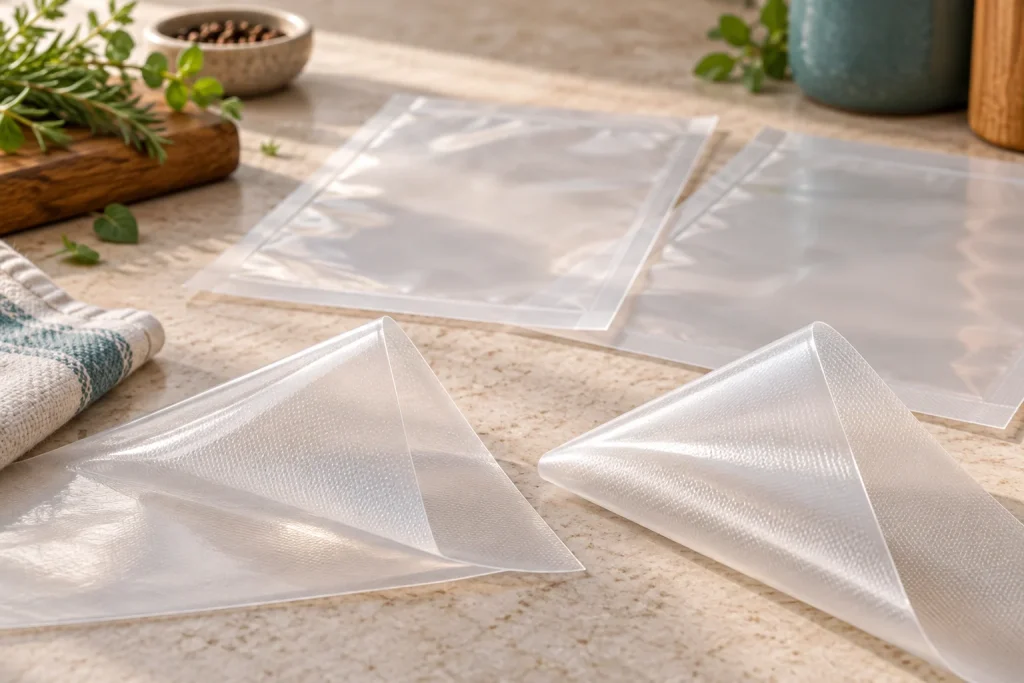
The 3 mil vs 4 mil vacuum sealer bag decision should follow the package you need to protect. Four-mil material is nominally thicker, but thickness alone does not establish puncture resistance, barrier performance, heat-seal quality or cooking suitability.
Start with the correct construction for the machine, then the load’s shape and the supplier’s intended use. Compare suitable bags for the same job rather than assuming the larger number is always better.
What a mil means
A mil is one thousandth of an inch, not a millimeter. Using NIST’s conversion factors, one mil equals 0.0254 mm, or 25.4 micrometers.
| Nominal thickness | Inches | Millimeters | Micrometers |
|---|---|---|---|
| 3 mil | 0.003 | 0.0762 | 76.2 |
| 4 mil | 0.004 | 0.1016 | 101.6 |
Four is about 33% greater than three. That arithmetic describes nominal thickness only. It does not mean 33% more puncture resistance or 33% longer storage life.
Ask whether the supplier’s number describes one wall, an average, a minimum or another convention. Comparing two listings using different conventions can create a false impression of relative thickness.
Begin with compatibility
The pouch must fit the exact machine’s opening width, chamber arrangement and approved material settings. Smooth chamber pouches and textured suction bags have different typical roles.
A four-mil smooth pouch is not automatically a substitute for the embossed bag an external machine needs. Equally, a compatible construction can still be too wide or long for your chamber.
Our bag compatibility guide addresses construction. The size guide addresses the filled package. Complete those checks before comparing thickness.
When a thicker pouch deserves investigation
A sharp bone or projection can make puncture protection more important than for a smooth portion. VacMaster’s thickness guidance suggests considering thicker material for relevant bony products and identifies its bone-guard option.
That is supplier guidance for a packaging problem, not proof that every four-mil bag is puncture-proof. Laminate, sharpness, loading, seal quality and storage abrasion all matter.
Inspect the package where it contacts the sharp feature. If the supplier recommends a compatible food-contact protective product, use that approved approach. Do not insert household paper, cloth or other material without confirming suitability.
When three mil may be sufficient
For a compatible pouch and an ordinary smooth load, a suitable three-mil product may meet the supplier’s intended use without paying for extra thickness. Verify the exact product’s documentation rather than relying on a category assumption.
If you have a successful routine, examine what problem a thicker pouch would solve. Would it address a recurring puncture location or simply add material to every package? The answer helps decide whether the upgrade is useful.
Nominal thickness does not establish a comparative puncture rate or storage life. Compare material suitability for the same food, handling and storage conditions.
Heat sealing needs material-specific guidance
A different pouch can require a different approved heat setting. More heat is not automatically better, and a thickness label alone does not supply a seal-time recipe.
Use the machine and supplier guidance for the actual laminate. Keep the mouth clean and flat. A fold or food residue across a seam can interfere with a thick bag just as it can with a thinner one.
If a seam is weak or distorted, diagnose the symptom before increasing the setting. Our troubleshooting hub separates material, loading and consumable issues.
Do not infer cooking approval
A storage pouch may have different permitted conditions from a cooking pouch. Obtain the exact temperature, duration and preparation requirements for the selected product.
FDA’s food-contact explanation describes assessing materials under their intended conditions of use. That is why a generic thickness or BPA-free statement cannot substitute for cooking authorization.
Our cooking-rating article examines those records separately. Do not turn a supplier’s limited heated-use statement into permission for every long cooking schedule.
Compare cost per successful package
Use equivalent dimensions, intended application and quantity. A hypothetical 100-pack costing $20 has a nominal cost of 20 cents per pouch. A hypothetical alternative at $25 costs 25 cents. Those are arithmetic examples, not current prices.
If the more expensive product solves a real puncture problem, evaluate the total successful-package cost using your own observations. If there is no measured difference in your routine, do not invent a saving to justify the upgrade.
Include the cost of any approved protective material and the quantity you actually use. Buying a large case of an untested size or laminate can create more waste than a modest higher-priced trial pack.
A fair way to compare your own materials
Use the same compatible machine, comparable representative loads, approved settings and storage conditions. Record supplier, pack identity, thickness definition and the exact failure observed.
Inspect seams and puncture locations separately. A failure at a contaminated opening should not be counted as proof of inferior puncture resistance. A sharp edge that changes between loads also makes the comparison less fair.
Keep food-safety decisions independent of the trial. Do not extend a storage period because one bag looks tighter or because no leak was visible in a small sample.
Questions buyers ask
Is four mil always stronger than three mil?
It is nominally thicker under the same definition. Strength and puncture behavior depend on more than that one number, so compare suitable products and relevant evidence.
Is three mil the same as 3 mm?
No. Three mil is 0.0762 mm using the stated conversion. Three millimeters would be a very different thickness.
Should all bone-in meat use four mil?
Follow the exact supplier’s packaging guidance and assess the actual sharp feature. A universal number does not replace an appropriate package and protection method.
Does thicker material need maximum seal time?
Not as a blanket rule. Follow the approved setting for the film and machine, then inspect the result.
Choose the thickness for a reason
Use a compatible pouch, identify the actual packaging challenge and choose an appropriately documented material. Upgrade thickness when it addresses a real requirement. Keep strength, cooking and shelf-life claims tied to their own evidence.
About the author
James
James helps home users choose chamber vacuum sealers, find compatible pouches and build a practical sealing routine. Our guides cover buying decisions, model comparisons, setup, maintenance and everyday ownership.