
Amazon links are affiliate links. As an Amazon Associate I earn from qualifying purchases. If you buy through these links, we may earn a commission at no extra cost to you. Affiliate disclosure.
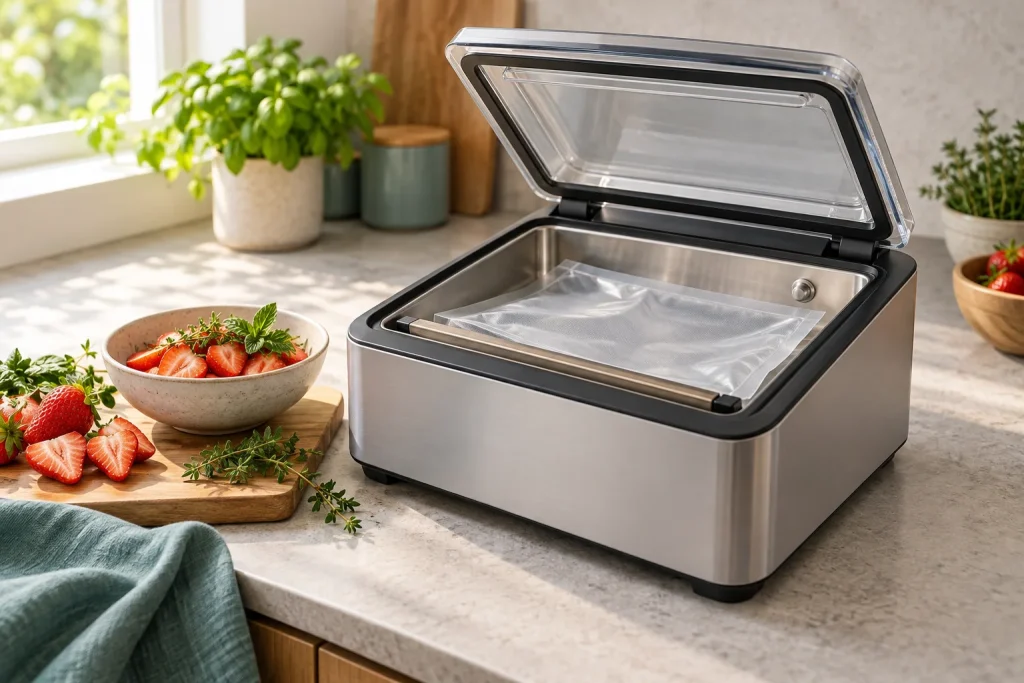
This Anova chamber vacuum sealer review considers a compact machine that combines ordinary packaging with documented culinary preset functions. It is most worth investigating when your portions fit and you expect to use that interface, rather than when you simply want the longest possible package.
The documented starting point
| Detail | Manufacturer-stated information |
|---|---|
| Chamber | 12 × 8.6 × 3 inches |
| Closed body | 13.6 × 11.2 × 8.9 inches |
| Seal bar | 11.8 inches |
| Pump | Dry design |
| Interface | Preset applications and manual control |
Compare the exact model and bundle on Amazon. Confirm the selected seller, included items, warranty and delivery before ordering.
Source: Anova’s chamber product page. These figures are not our measurements. A seal-bar length is not a guaranteed maximum filled-food width, and chamber volume is not a substitute for the correct pouch arrangement.
Who should investigate it
It is a plausible candidate for a household seeking chamber packaging in a compact format, particularly if the documented infusion and compression functions fit its cooking routine.
It is less compelling when you only need occasional dry-food packaging that an existing external machine already handles, or when your ordinary portion is longer than the approved chamber arrangement. Extra modes do not fix a capacity mismatch.
List the recurring problem the purchase should solve. If the answer is mainly a vague expectation of fresher food for much longer, obtain appropriate food-storage guidance rather than turning that expectation into a product score.
Fit comes before functions
Use the intended chamber pouch and a representative portion. Check filled height, width, opening orientation and the clean area at the sealing assembly. Do not treat the empty pouch dimensions as the maximum food block.
Anova sells a chamber-specific pouch product, distinct from its external-sealer material. That is a useful identification point, but verify your intended package and any alternative supplier before buying a large quantity.
Our sizing worksheet helps compare the loaded shape and workspace. If the fit is marginal, obtain a demonstration or manufacturer confirmation rather than improvising around the lid.
Preset applications: useful when they match your cooking
The maker’s chamber-use explanation describes infusion, compression and other culinary applications. These are reasons to read the approved processes, not evidence that every recipe, vessel or food can be used interchangeably.
Distinguish an open-container culinary process from making a sealed pouch. A vessel that fits physically may have a different required loading arrangement, and a preset name does not establish a safe preservation process.
If you will rarely use those functions, give them little weight in the purchase. Compare the ordinary filling, loading, sealing and cleaning routine first.
Manual control and package inspection
The documented interface also permits manual selections. Read what each selection changes and how to stop or advance a cycle. Similar button names on another brand can perform different actions.
Record the actual settings with the pouch material and food load. That creates a starting point for your own routine, but it does not make the result identical across all food or bag types.
Inspect the complete seal and package after the cycle. Online star averages and advertising phrases do not establish repeated-cycle reliability.
Liquids and bubbling
Chamber operation is relevant to wet-food packaging, but it does not eliminate overfilling or movement toward the bag mouth. Follow the exact liquid and temperature guidance, with a clean sealing area and a supported pouch.
Know the approved stop response before starting. Do not force the lid or treat bubbling as evidence that the food has been cooked or made safe for room-temperature storage.
Our liquid operating guide separates equipment behavior from food preparation and storage. A more aggressive setting is not automatically a better choice for every liquid.
Working space and electrical version
Measure the open lid, not only the closed body. Include the maker’s clearance requirements, a stable work surface, loading room and the cord route.
Buy the correct supply version. The manufacturer’s chamber documentation warns against unmatched voltage and inappropriate converter or adapter use. A familiar plug is not sufficient evidence of electrical suitability.
Think about storage too. A compact body is useful only when lifting, access and permitted orientation suit the location you intend to use.
Cleaning and support
Follow the component-specific instructions and isolate the machine as directed before cleaning. Do not assume another brand’s removable tray or washable seal bar process applies here.
Check the current service route, availability of owner-replaceable consumables and the warranty applying to the selected seller and country. A period shown on a sales page should not be expanded into a lifespan prediction.
The cleaning guide and warranty checklist organize those questions. They do not certify coverage for an unverified offer.
What strengthens the buying case
The combination of compact chamber packaging and a documented culinary interface gives the product a clear place to investigate. If the portion fits and the preset methods are genuinely useful, those features can matter more than a slightly different nominal dimension on another model.
Choose the Anova for its fit, controls and culinary functions. Check comparable measurements before making noise, speed or spill-resistance a deciding factor.
Alternatives and tradeoffs
The USV20-versus-Anova comparison is useful when explicit timed control versus the cooking-oriented interface is central. The compact-machine guide broadens the candidate set.
For long packages, reconsider suitable external equipment. For larger batches, require the exact session guidance rather than assuming this compact model can meet a production routine.
Questions before purchase
Is this the same as the Precision Vacuum Sealer Pro?
No. Identify the chamber model explicitly. Shared brand language does not make the external machine’s pouches, dimensions or manual applicable.
Can the preset functions replace canning?
No preservation claim is established by a preset mode. Follow authoritative food-preservation guidance for the actual food and process.
Have you tested it against USV20?
No. Choose between them by filled-pouch fit, controls, cooking functions and working space. A different feature set does not establish better sealing performance.
Review conclusion
Investigate Anova when its documented interface and compact chamber suit your actual cooking and packaging jobs. Confirm the loaded pouch and installation before valuing extra modes. Until original testing is available, the review supports a shortlist decision rather than an unqualified best-product claim.
About the author
James
James helps home users choose chamber vacuum sealers, find compatible pouches and build a practical sealing routine. Our guides cover buying decisions, model comparisons, setup, maintenance and everyday ownership.