
Amazon links are affiliate links. As an Amazon Associate I earn from qualifying purchases. If you buy through these links, we may earn a commission at no extra cost to you. Affiliate disclosure.
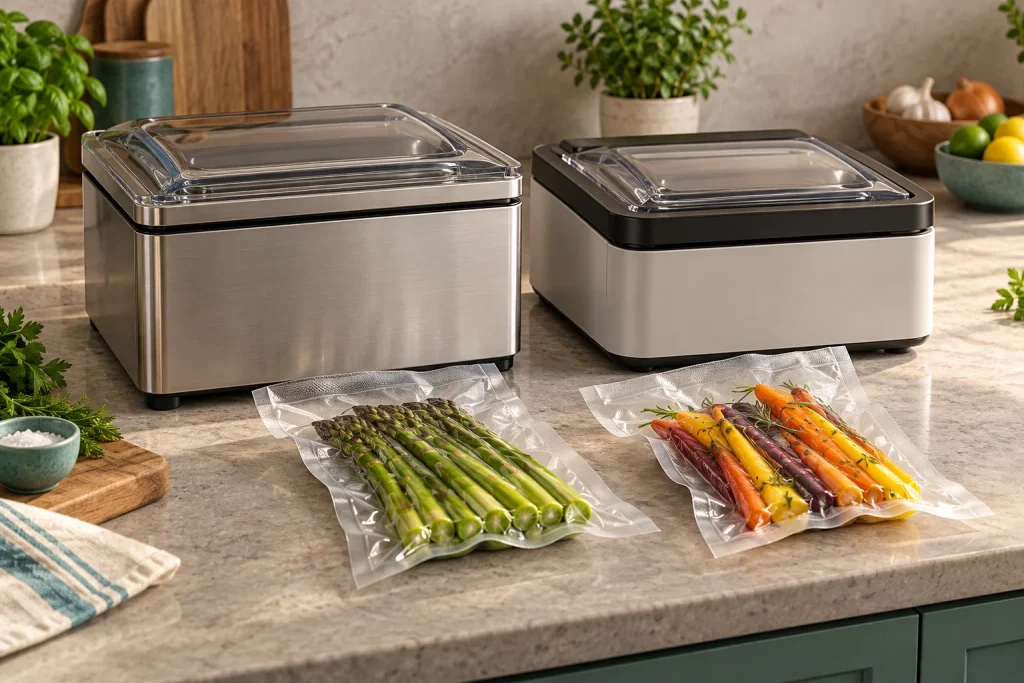
The Avid Armor USV20 vs Anova chamber vacuum sealer decision comes down to usable fit, the controls you want and the way the machine fits your kitchen. Both are compact chamber candidates. Neither should be chosen solely because a specification table shows a slightly wider chamber or a longer seal bar.
Choose the USV20 for closer investigation if you prefer explicit time adjustments and want to use its documented pouch ecosystem. Investigate Anova if its cooking-oriented preset functions are important to you. For either, confirm that your normal filled packages fit before weighing extra features.
Published specifications that affect the decision
| Detail | Avid Armor USV20 | Anova Precision Chamber |
|---|---|---|
| Published chamber dimensions | 12.25 × 8.5 × 3 inches | 12 × 8.6 × 3 inches |
| Published closed dimensions | 14 × 12 × 8.25 inches | 13.6 × 11.2 × 8.9 inches |
| Controls emphasized by maker | Adjustable vacuum and seal times | Preset applications and manual adjustment |
| Oil service | Dry-pump design | Dry-pump design |
| Fit question to resolve | Opening orientation and loaded pouch | Supported pouch and loaded clearance |
Compare the exact model and bundle on Amazon. Confirm the selected seller, included items, warranty and delivery before ordering.
Dimensions are manufacturer figures, not our measurements. Sources: USV20 specifications and Anova specifications. Width/depth labels and usable shapes should be confirmed before comparing a particular package. A rectangular dimension table does not show every obstruction.
Quick decision by household routine
| Your main requirement | Where to start | Why |
|---|---|---|
| Repeat a recorded setting for a familiar pouch | USV20 | Its timed control scheme makes the chosen intervals explicit |
| Experiment with the maker’s infusion and compression functions | Anova | Those applications are an important part of its interface and documentation |
| Package a bulky regular portion | Neither yet | Complete the filled-pouch measurement first |
| Store the machine beneath a cabinet | Both, conditionally | Check the open lid, not only closed height |
| Replace an external sealer mainly for long bags | Reconsider the equipment type | A compact chamber may introduce a new package-length constraint |
These are reasons to investigate a candidate, not evidence that one produces a better seal. The right controls cannot compensate for a package that does not fit.
Pouch fit is the first deciding factor
Begin with the same three filled packages for both machines. Use the bag construction and loading arrangement each manufacturer allows. Record the clean neck needed at the opening as well as the food dimensions.
The published chambers look similar in depth. Small differences in a table should not be turned into a claim that one handles larger meals overall. Seal-bar position, pouch opening, load shape and lid clearance can change the outcome.
Avid Armor publishes a supported-pouch list for the Ultra Series, including USV20-specific options. That is useful when checking replacement packs, but an approved empty bag still does not establish the maximum portion you can load into it.
For Anova, verify the exact chamber pouch you intend to buy rather than transferring a bag limit from another Anova sealer. The company’s external Precision Vacuum Sealer and Precision Vacuum Sealer Pro are different machines. Product names containing “Precision” are not enough to identify the correct documentation.
Our sizing worksheet provides a common way to compare the two without guessing from chamber volume.
Timed control versus preset applications
The USV20 exposes vacuum and seal time adjustment as part of its control approach. That can suit someone who wants to record a setting for a particular pouch and repeat the same selected intervals.
A recorded setting is not a guarantee of identical results. Different food loads, moisture, pouch construction and the machine’s condition can still affect the package. It is more accurate to call this control repeatable than to call its performance proven consistent.
Anova emphasizes preset applications as well as manual adjustment. Its chamber-use explanation describes infusion and compression uses. This may be attractive if those tasks are part of your cooking routine, but extra modes should earn their place in the decision.
If you primarily portion meat for the freezer, compare the ordinary packaging workflow first. If you expect to use infusion modes, read the actual approved container and loading instructions. A mode name does not authorize every liquid, vessel or preservation process.
Counter footprint and lid clearance
Draw each closed machine at full size on paper and place it in the planned position. Allow the clearances required by the manual, a safe cord route and space for loading.
Then check the open lid. A shorter closed appliance may still need more opening room. If a manufacturer does not state the required height, ask for it before assuming the machine will operate beneath your cabinet.
Also decide whether the machine stays in place. Comparing closed depth alone is less useful when you must lift it into storage after every session. Consider hand access and the route to the cupboard, not just the space on the shelf.
Liquids: compare loading instructions, not slogans
Both machines are sold as chamber equipment for wet-food applications. That should not become a promise that either seals warm soup without bubbling or can use a completely full pouch.
Before buying for liquids, read the supported fill and loading process. Consider where liquid will sit relative to the pouch mouth and how you would clean a spill. Never infer dishwasher approval from a component merely being removable.
The operating method belongs in our liquid-sealing guide. This purchase comparison does not replace either machine’s instructions or establish food storage times.
Costs and support to check at the selected seller
Compare delivered equipment cost, compatible bags, spare consumables and return conditions. We are not quoting current Amazon prices or stock. A manufacturer’s product page does not establish what a particular marketplace seller includes.
Check the selected model, voltage, seller and bundle. Confirm which warranty applies to your purchase country and intended use. A headline warranty period is less useful than knowing who handles a fault and whether your seller is eligible.
Use our ownership-cost guide for a transparent calculation. Do not assign savings to a preset you will not use or assume a dry pump removes every future maintenance cost.
Benefits and limitations of each choice
The USV20’s appeal is a clear timed-control approach and accessible model-specific pouch guidance. Its limitation is that a compact chamber remains a compact chamber: generous marketing examples do not make every roast or meal fit.
Anova’s appeal is the combination of ordinary chamber packaging and cooking-oriented functions. Its limitation is that those functions may add little for someone who only needs straightforward freezer portions. Documentation should establish the actual process, not a broad assumption that more modes mean better packaging.
Questions buyers ask
Which is better for beginners?
Choose Anova if culinary presets are part of the intended routine; choose USV20 if recording vacuum and seal intervals is more useful. The easier interface is the one that suits those tasks. Both still need a filled pouch that sits correctly and a clean, flat sealing neck.
Which is better for soup?
USV20 is our starting choice for smaller liquid portions and adjustable timing, with a half-full pouch limit. Choose Anova when the same portion fits and culinary presets are a regular additional use. If the preferred serving cannot lie below the sealing area, a different layout matters more than either interface.
Can the same bag pack be used in both?
Potentially, if it is smooth chamber material and its opening and loaded shape fit both machines. Anova’s own chamber pouches are about 11 × 9.8 inches, while USV20 lists a maximum flat format of 11 × 10. Check the specific pack’s orientation and material rather than substituting Anova’s external rolls.
Our buying judgment
Start with the USV20 if explicit timed control and its documented pouch options suit your packaging routine. Start with Anova if you will use its documented cooking applications and prefer that interface. If neither passes your filled-pouch and workspace checks, broaden the shortlist rather than choosing the less unsuitable machine.