
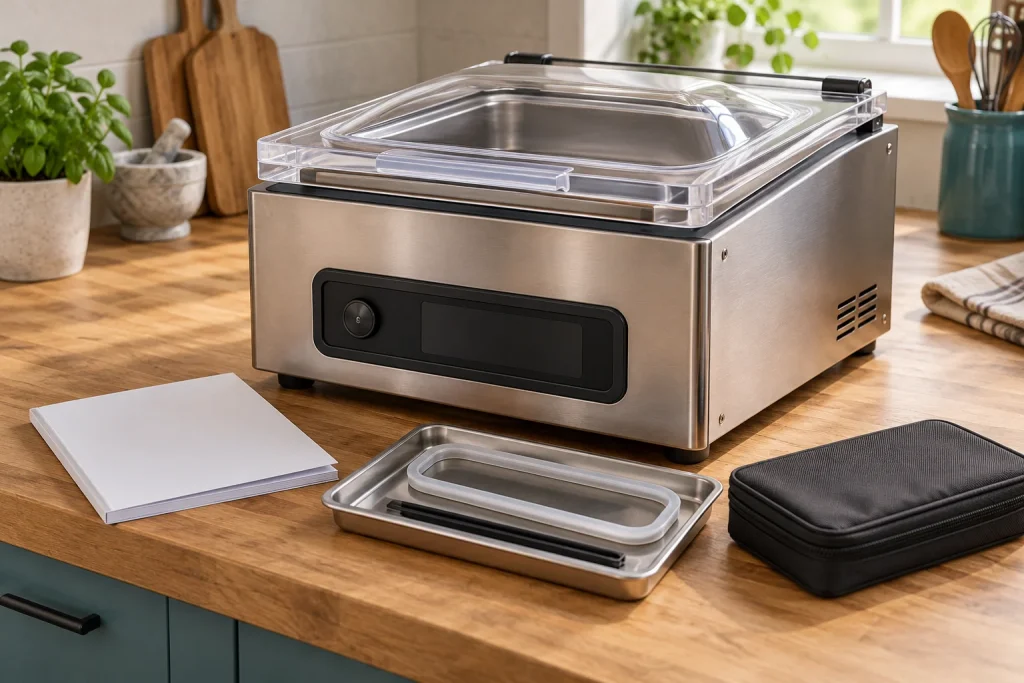
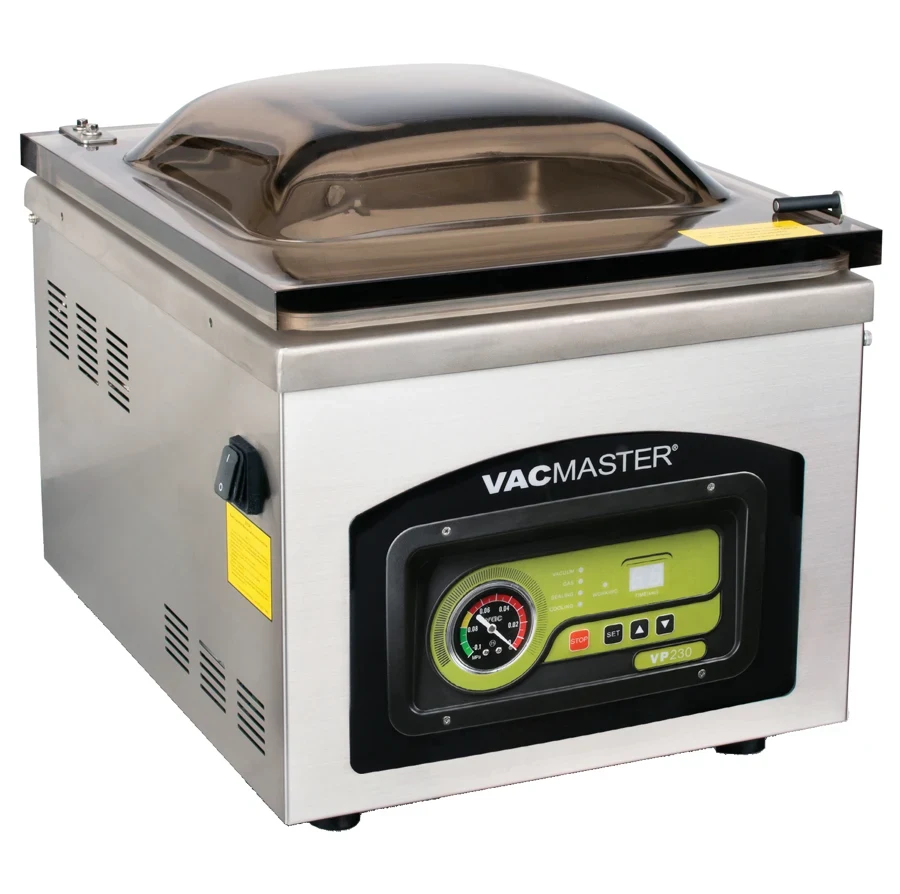
The VacMaster VP230 is a substantial 12.25-inch-bar chamber vacuum sealer built for a fixed work area rather than casual cupboard storage. Its deep 12.5 × 15 × 5-inch chamber and 1/2 HP rotary oil pump make it a sensible candidate for wide packages and repeated batches. The real questions are installation, oil maintenance and finding a supported unit: current specialist listings include advance-order offers, while other dealers report it unavailable. This review separates the machine’s documented capabilities from retailer stock claims.
The purchase recommendation remains conditional on current model, support and offer verification. The VP230 is not prominently listed in the manufacturer’s current chamber-machine catalog. That is not proof of discontinuation, but it is a reason to confirm supply and service before paying for a new or used unit.
Quick verdict
Quick verdict: A capable wide-chamber workstation for serious food packaging, provided you have the counter, handling plan and oil-maintenance routine. The VP230 is a poor convenience purchase for a small kitchen.
- Best for: dedicated food-packaging workstations, hunters’ processing areas and regular wide-pouch batches.
- Advantages: 12.25-inch double-wire seal bar, 5-inch chamber height, adjustable controls and documented oil-pump design.
- Trade-offs: about 89 lb, routine oil care, larger footprint and seller-dependent advance-order/availability conditions.
Check VP230 advance-order details at a specialist retailer
The source record and its limitations
The manufacturer-linked operator manual carries a 2018 version mark. A VacMaster-authored specification sheet hosted by a retailer supplies additional published specifications. These are useful documents, but they do not establish the exact specification or condition of every currently offered machine.
Use the selected unit’s model and revision for dimensions, maintenance and bag orders. Confirm current supply and support rather than treating an older specification sheet as a live offer.
Published figures to use for an initial fit check
| Detail | Referenced specification sheet |
|---|---|
| Chamber | 12.5 W × 15 D × 5 H inches |
| Seal bar | 12.25 inches |
| Overall machine | 15.5 W × 19 D × 15.75 H inches |
| Pump | Rotary oil design |
| Stated weight | 89 pounds |
Source: manufacturer-authored VP230 sheet. These are document figures, not measurements of the selected unit. Confirm revision, mass, electrical requirements and supported pouch before installation or purchase.
Who might have a reason to investigate it
A household with a dedicated work surface and regular portions needing the documented wider format has a clear reason to examine the model. Its handling and service requirements make more sense in a planned station than in a routine involving frequent cupboard storage.
The model is less convincing when a compact chamber already fits your food or when current support cannot be established. Buying a heavier machine does not automatically improve the package or reduce total work.
Use the size guide with your actual portion. Do not assume a wider sealing bar solves a load-height or package-length problem.
Oil-pump setup is part of the purchase
The operator manual describes adding oil before use and model-specific level checks. Do not assume a machine arrives ready to operate with the correct oil level or that the full supplied bottle is the correct fill.
Obtain the instructions for the exact unit. The manual’s use of a sight-glass level is a reason to follow that method, not to borrow a measured volume from another model.
Ask who can perform routine service and where the correct oil and parts can be obtained. A used machine with an unknown service record needs extra assessment; a fresh-looking chamber does not establish internal condition.
The oil-maintenance guide explains what to record without prescribing one schedule across all pumps.
Controls and cycle timing
The documented control system separates vacuum, sealing and cooling selections. That is useful when recording a setup, but a chosen interval is not an independent performance measurement.
The specification sheet’s cycle-time claim should be treated as the maker’s figure. It does not include every minute spent filling, loading, inspecting, pausing and cleaning in your session.
Ask for current workload guidance and supported rests. Do not infer nonstop production from an oil pump, machine mass or the word commercial. Our duty-cycle worksheet provides a complete-session framework.
Pouch width and food shape
Choose a compatible pouch with the correct opening and leave the clean neck required by the actual manual. The supported empty bag and the usable food envelope are different.
A wide irregular cut may still interfere with the sealing position or lid. A long fillet may need a different package arrangement. Obtain a comparable demonstration if the fit is marginal rather than buying a case of bags around an assumption.
For sharp contents, follow appropriate material and approved protection guidance. Extra thickness is not a guarantee against puncture or damage during storage.
Cleaning and service access
Read the model’s approved cleaning instructions before evaluating cleanup convenience. Accessible chamber residue is different from contamination inside the pump path.
The manual contains parts information, but a diagram is not evidence that every part is currently supplied or that every repair is owner-approved. Ask for current part availability and the service boundary for the exact revision.
Our replacement-parts guide helps identify the terms to use. Do not treat a spare gasket as proof the rest of an older machine will be straightforward to repair.
The purchase checks that matter most here
Ask the manufacturer or selected seller to confirm whether the unit is new, refurbished or used; its exact model and revision; warranty eligibility; current service support; and the correct manual. Confirm the actual mass and electrical label before arranging delivery and placement.
If offered as new-old stock, ask how it was stored and what warranty starts at sale. Do not assume the age of a listing or a recently retrieved page proves recent manufacture.
An Amazon title identifying VP230 is identity evidence only. It does not establish the seller, delivered condition or a reliable current offer. No current Amazon price or stock claim is made in this review.
Alternatives to compare
The VP210-versus-VP215 comparison is relevant when you do not need the VP230’s documented wider package class. The bulk-meat guide compares other workstation approaches, including an external alternative for suitable long packages.
If compact household portions are the actual job, revisit the small-kitchen shortlist rather than assuming a large bench model is a better investment.
Questions about VP230 ownership
Is the VP230 discontinued?
The available catalog evidence does not settle that. Before paying for a unit, establish whether it is new stock, older stock or used, and whether replacement sealing parts and pump service are available. A missing catalog entry is a reason to ask those purchase questions, not enough evidence to label the model discontinued.
How should I plan for the VP230’s weight?
The referenced VP230 specification lists 89 pounds. Use that as an initial indication that this is substantial bench equipment, then get the selected unit’s packaged weight and base dimensions for delivery and support planning. The shipping carton, route and handling equipment create demands that the machine’s bare weight alone does not describe.
When does VP230’s wider format justify an upgrade?
Compare it when pouch-mouth width repeatedly rules out the smaller machine. Its approximately 12-inch bar class is the relevant change from a 10-inch pouch format. If the existing package already fits, compare the full session, cooling and service burden before assuming a larger cabinet or pump will improve the processing day.
VP230 specifications that change the decision
| VP230 specification | Published value | Why it matters |
|---|---|---|
| Chamber | 12.5 W × 15 D × 5 H in | Room for wider and taller packaged foods than many small countertop chambers. |
| Seal bar | 12.25 in; double seal wire | Check the pouch mouth and interior chamber together. |
| Pump | 1/2 HP rotary oil | Needs oil setup and ongoing maintenance. |
| Electrical | 110 V, 60 Hz, 4 A listed | Confirm the delivered model’s rating label before installation. |
| Overall size | 15.5 W × 19 D × 15.75 H in | Requires a permanent, stable work area with lid clearance. |
| Weight | 89 lb | Delivery, lifting and countertop support are meaningful costs. |
| Claimed cycle | 20–40 seconds | Not a complete throughput estimate; loading and cleanup take extra time. |
VacMaster publishes these specifications in its VP230 specification sheet. The operator manual provides the oil setup and safety procedure.
Buying a VP230 in 2026: availability and freight
A specialist dealer currently describes its VP230 as an advance-order item and says delivery is by freight. Other retail listings label the model unavailable. That is evidence of uneven distribution, not proof that VacMaster has formally discontinued it. Ask the seller for a written lead time and whether the machine is new current stock, backordered or stored inventory.
Because the machine weighs roughly 89 pounds before protective shipping materials, residential delivery can be more involved than delivery of a small appliance. Check freight fees, curbside versus inside delivery, damage inspection windows and the buyer’s responsibility for returns. Confirm a safe route to the work area, including doorways, stairs and the support rating of the counter. Compare this landed cost against a smaller machine before choosing on sealer price alone.
Oil-pump setup is not optional
The VP230 operator manual states that pump oil must be added before first use and shows a sight-glass target rather than asking owners to pour in an entire bottle. A unit that turns on without correct oil is not necessarily ready for a cycle. Use the manual supplied with the exact machine, keep it level while servicing and contact VacMaster about appropriate oil and part support. Never guess the maintenance schedule from a different VP-series model.
This requirement is one reason the VP230 is suitable for a consistent packaging station. Owners who seal a handful of dry snacks each month may find the additional setup and servicing disproportionate. Users with repetitive bulk processing can reasonably value a larger chamber, provided that service access and total workload justify the appliance.
Is the VP230 worth it against VP210 and VP215?
Start with the package, not the model number. If a 10-inch-class seal bar and smaller chamber fit your usual meals, the VP210-versus-VP215 comparison is a better starting point. The VP230 justifies consideration when the wider pouch mouth or taller chamber solves a frequent restriction. Bigger is not intrinsically better: its maintenance, working clearance, service access and shipping costs come with it.
- Choose VP230: when you repeatedly need its wider or taller packaging envelope and can support the 89-pound machine.
- Choose a smaller chamber: when regular portions already fit and space or frequent storage is the main concern.
- Skip an uncertain offer: when the seller cannot confirm warranty coverage, approved parts and realistic freight/return terms.
Review conclusion
The VP230 is a strong option for dedicated, larger-format vacuum packaging—not for a kitchen that needs a lightweight appliance. Its chamber, double-wire bar and rotary oil pump are well documented, and a specialist advance-order route exists. Compare the full delivered cost and verify service support before ordering, particularly when a marketplace listing does not clarify stock or revision.