
As an Amazon Associate I earn from qualifying purchases. Buying through our links may earn us a commission at no extra cost to you. Affiliate disclosure.
For smaller portions of soup, sauce and marinade, the Avid Armor USV20 is our first chamber-sealer choice. It combines adjustable timing with clear liquid-loading guidance and a compact household format. Choose a different model when your filled pouch needs more depth, your batch needs a permanent workstation, or removable cleaning components are a higher priority.
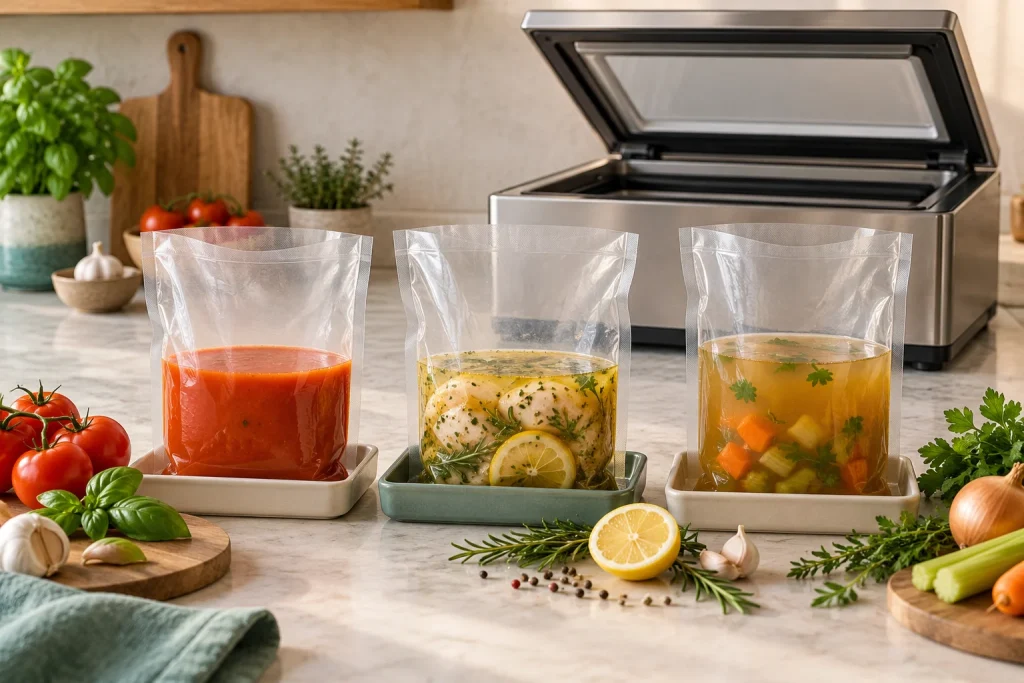
Buying a chamber vacuum sealer for liquids requires more than finding “soup” in the product description. The useful questions are how much food the pouch holds in its sealing position, how easily you can control a rising liquid, and what happens when cleanup is needed. This guide compares six machines around those decisions, then shows how to select one for your actual portions without paying for capacity or features you will rarely use.
Compare Our Picks
| Product | Best for | Main consideration | Pricing |
|---|---|---|---|
| Avid Armor USV20 | Regular smaller liquid portions | Half-full limit and supported pouch position | View on Amazon |
| Anova Precision Chamber | Packaging plus culinary functions | Separate pouch sealing from open-container modes | View on Amazon |
| LEM MaxVac Pro 1745 | A different loaded-pouch layout | Bundle contents and batch pauses | View on Amazon |
| VacMaster VP215 | A permanent packaging station | Oil service and substantial lifting | View on Amazon |
| Vesta Precision V513 | Removable tray and seal-bar access | V513 variant and component washing limits | View on Amazon |
| Wevac CV12 Pro | Deeper layout and automatic sensing | Choose Pro, not the standard CV12 | View on Amazon |
Start with the liquid you package most
Thin broth spreads differently from a thick sauce, and a chunky stew uses chamber height differently from either. Choose one representative meal or ingredient portion as your starting point. A machine suited to a small marinade pouch may be awkward for the quantity of soup you want to freeze for a household dinner.
Keep ordinary bag sealing separate from culinary processing. An infusion cycle in an open vessel and a sealed pouch of soup are different uses of the chamber. Compare the normal packaging arrangement first, then decide whether additional modes deserve a place in the purchase.
1. Avid Armor USV20 — Best for Smaller Liquid Portions

The USV20 works best for households that portion liquids modestly and want control over selected cycle intervals. Its supported pouches reach 11 × 10 inches, with a shorter chamber arrangement than the longer-pouch USV32. The practical buying boundary is the loaded portion, including the empty neck needed to reach the bar.
For liquids, the pouch should be filled no more than halfway. That rule is important because food moves toward the mouth when the bag is laid into the chamber. If your preferred serving requires exceeding that fill level, choose a different arrangement or machine instead of making the bag progressively fuller. The usable meal portion can be much smaller than the bag’s apparent upright capacity.
Adjustable timing suits a repeat recipe when you want to record the selected intervals and revisit them later. Watch the liquid throughout the cycle and follow the permitted stop or seal procedure when needed. We would choose the USV20 for a handful of regular soup or sauce portions, while looking elsewhere when depth or a larger session is the real requirement. Our USV20 review covers the wider ownership tradeoffs.
Why It’s Our Top Pick
The USV20 gives a smaller liquid-packaging routine a clear starting point: adjustable controls, a defined fill limit and a dry pump that avoids oil changes. It is our top pick when the preferred portion fits correctly and the machine can stay accessible in the kitchen. That recommendation rests on the match between the package and the task; a larger chamber is the better purchase when the same serving repeatedly exceeds the workable loading arrangement.
Key Features
- Adjustable vacuum and sealing intervals.
- Supported flat pouches up to 11 × 10 inches.
- A no-more-than-half-full loading rule for liquids.
Pros
- A useful fit for repeating smaller soup, sauce or marinade portions.
- Selected settings can be recorded alongside a familiar recipe and pouch.
- No pump-oil service added to the kitchen routine.
Cons
- Longer or larger liquid packages can exceed the usable envelope.
- A generous-looking pouch still needs substantial empty space.
- Timed control requires attention as food behavior changes.
2. Anova Precision Chamber — Best for Packaging and Culinary Functions

Anova appeals to cooks who want to package liquids and explore infusion or compression. Preset applications and manual controls share the same compact machine, so it can serve a wider culinary brief than a straightforward freezer-packaging purchase.
The key distinction is between a pouch that will be sealed and an approved vessel used for a culinary cycle. The food position, container and intended result can differ. If almost every session will involve finished meals for the freezer, evaluate the ordinary bag-loading process first. If you regularly prepare infused ingredients, the extra applications become a more persuasive reason to choose it.
Its chamber is approximately 12 × 8.6 × 3 inches. Compare the filled pouch in that space rather than judging capacity from an attractive open-container demonstration. We would shortlist Anova when the usual portion fits and its extra functions will be used repeatedly. We would prioritize another layout if buying it means dividing every soup serving into more packages than you want. The Anova chamber review explains its controls and model-specific fit.
Key Features
- Culinary presets alongside manual operation.
- A chamber approximately 12 × 8.6 × 3 inches.
- Dedicated chamber pouches, distinct from Anova external-sealer material.
Pros
- Combines freezer packaging with additional cooking applications.
- Gives a choice between preset and manual processes.
- Suits cooks who value the chamber as part of food preparation.
Cons
- Extra modes do not increase the size of a normal sealed meal pouch.
- Approved vessel use needs a separate check from bag compatibility.
- Its relatively shallow chamber may limit the preferred liquid portion.
3. LEM MaxVac Pro 1745 — Best Alternative Layout for Bulky Pouches

LEM’s MaxVac Pro 1745 deserves attention when the shape of a loaded pouch causes trouble in a shallower machine. Its listed chamber depth is 3.93 inches, with a removable insert and heat bar. That different arrangement is worth comparing for chunky food as well as free-flowing liquid.
Depth is only useful when the sealing position uses it effectively. A tall mound of stew can still leave the neck difficult to position or bring food against the lid. Compare the portion you intend to serve, including solid pieces and liquid, rather than treating the full chamber as a measuring jug. The usable arrangement also changes when an approved insert is fitted.
Batch planning is the other purchase consideration. The 1745 needs a longer rest after 30 continuous seals, and LEM advises between-cycle cooling for the heating element. A household packing a few portions may find that easy to accommodate; a large soup-preparation day needs an explicit pause plan. Choose the 1745 for its layout and dry-pump ownership when those requirements suit the work. The Amazon option is a bundle, so check the included items rather than comparing machine names alone.
Key Features
- Adjustable vacuum and seal controls with a dry pump.
- A 3.93-inch listed chamber depth.
- Removable insert and heat bar.
Pros
- An alternative geometry for a thicker filled meal pouch.
- Avoids routine pump-oil changes.
- Removable components provide access during approved cleaning.
Cons
- Depth does not remove fill, lid or mouth-position limits.
- Large sessions need cooling and longer-rest planning.
- Pro 1745 and oil-pump Pro+ 1380 are different machines.
4. VacMaster VP215 — Best for a Dedicated Liquid-Packaging Station

The VP215 is the bench-machine choice for buyers who want a permanent packaging station and accept oil-pump upkeep. Its 10 × 13-inch pouch class offers a different format from the shorter compact models, while the serviceable rotary oil pump changes the ownership commitment.
We would consider it for a kitchen or preparation room where the machine can stay on stable support with access for cleaning and maintenance. That setting matters because a heavy appliance loses much of its convenience when it has to be moved before each small batch. Plan where the food will be filled, where the pouch will be loaded and where completed portions will go.
Oil service is a responsibility to accept deliberately. Follow the selected unit’s startup, oil-level and change instructions, including any response required after moisture problems. Choose the VP215 because its supported workload and packaging layout fit a recurring job, rather than assuming an oil pump is necessary for every liquid. The VP210 versus VP215 comparison explains the alternative ownership choices without turning pump type into a universal performance ranking.
Key Features
- Rotary oil-pump chamber design.
- A 10 × 13-inch supported pouch class, subject to loaded fit.
- Bench-machine setup with specified oil maintenance.
Pros
- A sensible option for a permanent, organized packaging station.
- A longer pouch format than the shortest compact choices.
- Serviceable pump ownership for buyers willing to maintain it.
Cons
- Substantial support and moving requirements.
- Oil checks and servicing become recurring tasks.
- A commercial label does not establish unlimited nonstop operation.
5. Vesta Precision V513 — Best for Access to Wet-Food Cleanup Areas

Vesta’s removable tray and washable seal-bar assembly address a practical ownership question: how easily can you reach the parts that collect residue? For regular sauces or marinades, cleaning access can be more valuable than another advertised cooking mode.
The V513 has a 12.3 × 8.8 × 3.7-inch chamber and SmartVac automatic control. That combines a somewhat deeper layout with fewer manual vacuum-time selections. Compare how the actual pouch sits on the tray and reaches the bar. Automatic sensing still requires suitable filling and a clean sealing area; it is not a reason to fill a liquid bag close to the opening.
The V553 is a separate, longer variant on the same family page. Select V513 when using the specifications in this guide, and confirm the current return and warranty route for the chosen seller. We would shortlist Vesta when removable cleaning parts and its control approach are the strongest match. Before buying, also consider where those parts will dry and how they are refitted, because that is part of the real reset between sessions.
Key Features
- SmartVac automatic control.
- Removable tray and washable 12-inch seal-bar assembly.
- V513 chamber dimensions of 12.3 × 8.8 × 3.7 inches.
Pros
- Accessible removable components for a regular wet-food routine.
- Appeals to buyers who prefer fewer manual timing selections.
- Offers another chamber shape within a countertop format.
Cons
- Component washing permissions do not extend to the full appliance.
- V553 dimensions cannot be used to assess V513 capacity.
- Spill prevention still depends on the loaded pouch and operator.
6. Wevac CV12 Pro — Best Larger-Layout Alternative with Automatic Control

The CV12 Pro is worth comparing when a broader, deeper liquid-pouch arrangement is the priority. Its listed chamber is 12.4 × 12.8 × 3.8 inches, alongside automatic vacuum control, a removable tray and a washable seal-bar assembly. Those features create a different comparison from choosing only between the smallest household machines.
Use the dimensions to assess the supported loaded shape, not to calculate a promised soup capacity. A broad bag can spread food in a way that improves positioning, but the mouth still needs the correct relationship to the bar and the liquid level. The volume of an empty rectangular space cannot establish how a partly filled flexible pouch behaves during a cycle.
Make sure the selected item is CV12 Pro. The standard CV12 is a different model, and similar product names should not carry specifications from one machine to the other. We would choose the Pro when its layout resolves a real portion problem and the control and cleanup approach fit the household. Confirm support, return terms and compatible replacement parts before treating a larger machine as the simpler ownership choice.
Key Features
- A 12.4 × 12.8 × 3.8-inch listed chamber.
- Automatic vacuum control and a 12-inch seal-bar format.
- Removable tray and washable seal-bar assembly.
Pros
- More room to compare alternative liquid-pouch layouts.
- Automatic controls reduce selected timing decisions.
- Removable parts provide access for appropriate cleaning.
Cons
- The Pro identity must match the selected offer.
- Extra chamber space brings a larger placement commitment.
- Automatic sensing does not replace monitoring or package inspection.
Quick Tips
- Choose the portion before the machine; measure it in the sealing position.
- Leave the fill allowance required for the exact model.
- Keep the pouch neck clean and flat across the sealing area.
- Learn the permitted stop or seal controls before loading liquid.
- Plan prompt cold storage and a complete cleaning reset for the session.
Match Chamber Layout to the Food’s Behavior
Thin broth and chunky meals ask different questions
Thin liquids spread readily as the pouch is laid down. A bag that looks comfortably filled while upright can send food toward the mouth in a shallow chamber. Ask how the intended portion sits at the required angle and level, including the empty neck. A larger flat bag sometimes changes that geometry, but only within the machine’s approved arrangement.
Chunky meals add solid height as well as liquid. A piece of food near the sealing neck can prevent a flat mouth even when the total liquid amount looks modest. Compare the complete meal portion, rather than using water alone as a guarantee that every recipe will fit. Thick sauces may move differently again, so one successful arrangement should not become a universal fill rule.
Depth and portion volume are related, but not interchangeable
An extra fraction of an inch can matter when a familiar loaded pouch is close to the lid. It can also make little difference if the seal-bar position remains the main constraint. The useful comparison is the full arrangement: chamber floor, any approved insert, pouch mouth and lid clearance.
Before a costly purchase, describe the regular portion to the seller using pouch dimensions and its laid-down shape. If the answer is only a chamber-volume figure, ask how the pouch should be positioned. Our sizing guide explains the measurements worth collecting.
Understand the Controls Before Comparing Speed
Lowering pressure changes how liquids behave. Bubbling under vacuum can occur without the machine heating or cooking the food. Warm liquid is especially demanding, so plan appropriate cooling before packaging rather than expecting a longer cycle to solve movement in the pouch.
Identify the control that ends evacuation, starts sealing or cancels a cycle, and what the appliance does immediately afterward. These functions can have different meanings across models. A transparent lid helps observation, but visibility only matters when the operator knows which permitted action to take.
For repeated recipes, keep a short record of pouch size, portion, food temperature category and selected settings where applicable. That makes the next session easier to organize. Change the record when the material or load changes, and continue checking the completed seal. Our liquid-sealing operating guide covers the process beyond the buying decision.
Decide How Much Cleaning Access Is Worth
A removable tray can make residue easier to reach. A detachable seal bar can expose areas that would otherwise be awkward to inspect. Compare the component-specific cleaning process, including drying and reassembly, instead of assuming every detachable part is dishwasher-safe or immediately ready to refit.
Also ask what happens when liquid reaches an area outside ordinary owner cleaning. There should be a clear support route for an internal spill, unusual noise or a machine that behaves differently after contamination. Running another cycle is not a substitute for resolving a suspected internal problem.
Think about the counter around the appliance. A suitable filling vessel, clean bag supply and place for completed pouches can reduce messy handling before the cycle begins. Good access is especially valuable when the station must be dismantled after every session. The cleaning guide separates ordinary surface care from problems requiring support.
Plan the Batch and Cold-Storage Routine Together
A machine can suit one liquid pouch while being inconvenient for the number you want to produce. Count how many packages make the batch, then include filling, loading, inspection, required pauses and cleanup. A displayed vacuum interval is only one part of that time.
Bring out food in manageable amounts and keep the rest appropriately cold. Do not leave a large quantity waiting on the counter while comparing settings or servicing the machine. Perishable soup remains perishable after packaging; a tight pouch is neither a shelf-stable preservation process nor a new storage schedule.
Label portions so the original preparation date is not lost when the food is repackaged. Choose storage arrangements that make the portions easy to identify and use. Vacuum packaging should support a sensible meal routine, rather than create a freezer full of identical unlabeled bags.
Buy Around the Portions You Will Use Later
The easiest pouch to fill is not always the most useful meal package. Two servings in one bag reduce the number of sealing cycles, but opening that bag commits both servings to the next meal plan. Smaller portions use more pouches and handling time while giving more flexibility over what comes out of storage.
Decide which pattern suits the household before choosing chamber size. A machine should accommodate the preferred serving comfortably, with enough empty film for the required position. Buying a larger appliance just to pack several servings together may provide little benefit when those servings would be more useful separately.
Also consider how the completed package will lie in the freezer and how it will be identified. A broad pouch may suit a flatter portion, while a bulky shape can be awkward to organize. Keep labels readable and use suitable support where needed during freezing. The useful purchase supports both the packaging day and the meal when that food is finally used.
Questions Buyers Ask About Sealing Liquids
Is an oil pump essential for soup?
No. Several dry-pump chamber models support liquid packaging. Choose by the exact loading instructions, usable portion, session requirements and cleaning process. Oil-pump ownership becomes relevant when a particular machine suits the workstation and workload; the presence of liquid alone does not settle that purchase.
Can I package a whole pot at once?
Choose portions that fit the pouch and chamber correctly and that you actually want to thaw or use together. A pot’s total quantity is not a single-package capacity requirement unless you genuinely need it in one bag. Dividing the food into planned servings can also simplify storage and later meal preparation.
Does a wider seal bar let me fill the bag higher?
A wider mouth can allow a different pouch format, but it does not cancel the machine’s fill limit or required sealing position. The amount of food, its laid-down level and the clean neck must all work together. Compare the whole package instead of using bar width as a liquid-volume rating.
Can I reheat food in any chamber pouch?
Use the exact bag’s approved time, temperature and heating method. Compatibility with the sealer does not establish boiling, microwave or long sous vide suitability. If the intended method is unsupported, transfer the food to an appropriate vessel. Our pouch cooking-rating guide explains the distinction.
Will a longer vacuum time always remove more useful air?
It can also increase liquid movement or evaporation under the particular conditions. Follow the model’s instructions and observe the food. More time is not automatically the right endpoint for every sauce or soup, and a setting copied from another machine is not a substitute for understanding the controls.
How should I compare two close candidates?
First eliminate any machine that cannot support the normal loaded portion. Then compare the reset between packages, the number of timing selections, cleaning access and maintenance. If both pass those checks, compare delivered cost and support. An extra mode should decide a close match only when it serves a recurring use.
Our Buying Recommendation
Start with the USV20 for regular smaller liquid portions and adjustable timing. Choose Anova when culinary applications are a meaningful part of the plan, LEM when its layout fits the filled meal better, or VP215 for a permanent station with accepted oil maintenance. Vesta and Wevac offer removable cleaning components and automatic controls in different chamber layouts. The best purchase makes your preferred portion easy to load correctly, monitor and store, session after session.
About the author
James
James helps home users choose chamber vacuum sealers, find compatible pouches and build a practical sealing routine. Our guides cover buying decisions, model comparisons, setup, maintenance and everyday ownership.