
As an Amazon Associate I earn from qualifying purchases. Buying through our links may earn us a commission at no extra cost to you. Affiliate disclosure.
The best chamber vacuum sealers for small kitchens should fit two things: the food you normally package and the space where you will actually use it. A machine that disappears into a cupboard is appealing until every batch starts with an awkward lift. A larger chamber is useful until its open lid meets the wall cabinet.
Our first choice for modest portions and limited storage is the Avid Armor USV1. Choose the USV20 when adjustable timing and a wider pouch mouth matter, or Anova when you want cooking presets alongside freezer packaging. LEM and Vesta offer different chamber layouts, while the USV32 is the longer-pouch alternative for kitchens that can accommodate it. The right upgrade solves a recurring problem; extra capacity by itself is not a reason to surrender more counter space.
Compare Our Picks
| Product | Best for | Main consideration | Pricing |
|---|---|---|---|
| Avid Armor USV1 | Small portions and limited counter space | Presets; limited room for bulky loads | View on Amazon |
| Avid Armor USV20 | Adjustable timing in a compact format | Shorter pouch envelope | View on Amazon |
| Anova Precision Chamber | Packaging plus cooking presets | Extra modes may add little to freezer-only use | View on Amazon |
| LEM MaxVac Pro 1745 | A deeper alternative chamber layout | More handling and model-specific pauses | View on Amazon |
| Vesta Precision V513 | Removable cleaning components | Select V513; confirm seller support | View on Amazon |
| Avid Armor USV32 | Longer household pouches | Larger setup; check the current offer | View on Amazon |
Choose the shortlist that matches your routine
For a machine that comes out only on weekends, start with handling and storage access. For a machine that stays on the counter, prioritize comfortable loading and lid clearance. For a kitchen that packages several different foods, measure the largest regular portion rather than the most unusual item you might seal once a year.
Chamber machines also have a firm package-length limit. If long fish fillets or other oversized items dominate your work, compare an external sealer before stretching a compact chamber beyond its purpose. Our chamber versus external sealer comparison explains that equipment choice.
1. Avid Armor USV1 — Best for Small Portions
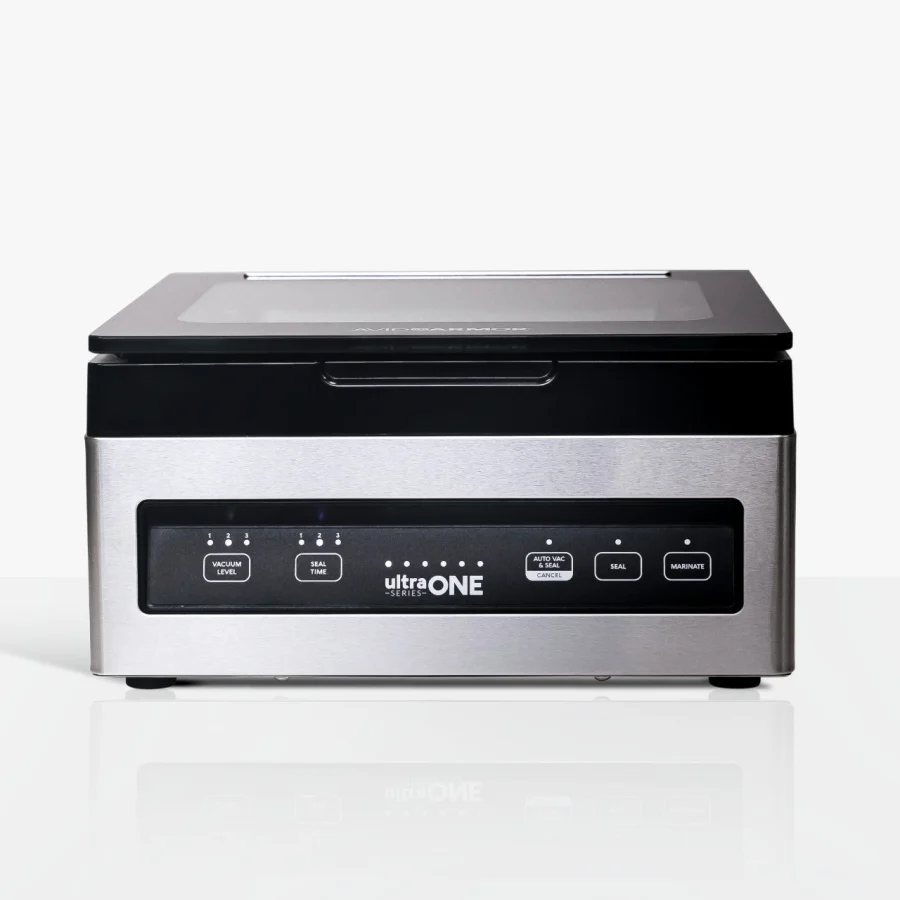
The USV1 is the clearest starting point when a smaller appliance is the main requirement. Its closed body measures 12 × 12 × 6.25 inches and weighs 13.05 pounds. Those figures make it easier to plan cupboard access than with a substantially heavier bench machine, although the actual shelf, grip and lifting route still decide whether storage is convenient.
Its 10-inch sealing bar and supported flat pouches up to 10 × 10 inches suit a routine built around smaller portions. Think about the package you want to take from the freezer for one meal. If you already divide food that way, a compact chamber can fit the routine naturally. If you prefer large undivided cuts, its shallow chamber becomes a compromise you will notice repeatedly.
The preset interface offers three vacuum levels and three seal settings. We favor that approach for buyers who want a short set of choices. Choose the USV20 instead if recording explicit time intervals is an important part of how you work. The USV1 versus USV20 comparison covers that distinction in more detail.
Why It’s Our Top Pick
The USV1 gives the small-kitchen brief a sensible priority: modest size, relatively manageable weight and straightforward controls. Its dry pump also avoids routine pump-oil changes. We would choose it when smaller filled packages cover most of the household’s needs, rather than buying a larger machine for occasional oversized food. The condition is simple: the normal loaded pouch must fit without pressing against the lid or forcing an inconvenient portion size.
Key Features
- A 12 × 12-inch closed footprint with a 6.25-inch body height.
- Supported flat pouches up to 10 × 10 inches.
- Preset vacuum and seal levels with a dry pump.
Pros
- A practical size for kitchens where the machine cannot occupy a permanent large station.
- Suits a repeat routine of smaller portions.
- Fewer initial control choices than an interface built around selected seconds.
Cons
- The shallow loaded space limits thick food packages.
- Not the choice for buyers who specifically want timed settings.
- Its weight still requires a suitable shelf and safe handling.
2. Avid Armor USV20 — Best for Adjustable Timing

The USV20 is the step to take when the USV1’s narrower pouch opening or preset controls are the limiting factor. It supports pouches up to 11 × 10 inches and lets you select vacuum and seal intervals. That makes it a useful choice for a household that wants to record settings for a few familiar bag-and-food combinations.
Its 14 × 12 × 8.25-inch closed dimensions need more room than the USV1. The more useful placement figure is the 17 inches required for its open lid. Measure the actual gap beneath your cabinets, including anything projecting downward. If the lid can open in its working position, you avoid having to move the machine forward for every package.
The tradeoff is pouch length. A wider mouth can help with broad food, but the shorter chamber arrangement will not accept every long cut that fits through that opening. Choose this model for the shape of your usual portion, not merely its seal-bar width. Our USV20 pouch-size guide shows why the opening edge and filled length need separate checks.
Key Features
- Adjustable vacuum and seal timing.
- Supported flat pouch size up to 11 × 10 inches.
- A 17-inch open-lid height and dry-pump design.
Pros
- Selected intervals can be recorded for repeat packaging tasks.
- Offers a wider supported pouch mouth than the USV1.
- A useful option when the lid clears the available cabinet gap.
Cons
- The shorter pouch envelope remains a restriction for long food.
- Weighs more and occupies more closed space than the USV1.
- Adjustable timing adds decisions when food or bag material changes.
3. Anova Precision Chamber — Best for Cooking Presets

Anova earns its place when the purchase is about cooking as well as storage. Its preset applications include infusion and compression processes, with manual controls available for ordinary packaging. That combination is more relevant to someone exploring chamber cooking techniques than to a household that only wants to portion meat for the freezer.
The closed dimensions are 13.6 × 11.2 × 8.9 inches, while the chamber is approximately 12 × 8.6 × 3 inches. The body can look compact on a product page, but its usefulness still depends on the loaded food and the clearance above it. Use the chamber dimensions to eliminate obvious mismatches, then check the actual permitted pouch arrangement.
We would choose Anova over the USV20 when its culinary functions are likely to become part of a regular cooking routine. We would choose the USV20 when explicit timing and its pouch system are the stronger fit. Anova’s chamber machine is also separate from the company’s external Precision sealers; bags and accessories with similar names are not automatically interchangeable. Read the USV20 versus Anova comparison if those are your final two options.
Key Features
- Cooking-oriented presets alongside manual operation.
- A chamber approximately 12 × 8.6 × 3 inches.
- Dry pump and a separate range of chamber pouches.
Pros
- Adds culinary applications to a home packaging setup.
- Gives buyers a choice between presets and manual controls.
- A clear alternative for cooks who value more than freezer storage.
Cons
- Extra functions offer little value when they will go unused.
- A compact body does not remove limits on thick or long food.
- External Anova rolls and bags are different products.
4. LEM MaxVac Pro 1745 — Best Alternative Chamber Layout

The LEM 1745 is worth considering when a different chamber shape solves the problem. Its listed chamber depth is 3.93 inches, greater than the flat chamber depth figures of the smaller Avid models in this guide. That creates a reason to compare bulky filled packages, although usable height also depends on the lid, insert and sealing position.
The machine weighs 22.5 pounds and has base dimensions of approximately 13.9 × 14.29 inches. That is a meaningful placement commitment for a small kitchen. We would prioritize a stable counter position over a low cupboard that requires frequent lifting. The removable heat bar and chamber insert also deserve attention when assessing everyday access and cleaning.
Choose the 1745 when its layout fits a regular food package better and you are comfortable with the session pauses. LEM’s Pro+ 1380 is a different oil-pump model, so a listing shortened to “MaxVac Pro” needs a closer look. The Amazon link here is for a 1745 bundle; compare its included items against what you already own rather than valuing every accessory as an essential purchase.
Key Features
- Dry-pump chamber system with adjustable timing.
- An 11.42-inch seal bar for bags up to 11 inches wide.
- Removable heat bar and chamber insert.
Pros
- A different chamber shape for food that is awkward in shallower alternatives.
- Avoids the oil-service routine of the Pro+ 1380.
- Removable components provide access for appropriate cleaning.
Cons
- Heavier and broader than the smallest choice here.
- Larger sessions require the specified pauses.
- Bundle names can obscure which MaxVac model is included.
5. Vesta Precision V513 — Best for Removable Cleaning Components

The V513’s main attraction is how its removable tray and washable seal-bar assembly fit into cleanup. This matters in a small kitchen, where the same counter may need to return to ordinary food preparation after each packaging session. Look at where those parts will be cleaned and dried, as well as where the machine itself will stand.
The V513 chamber measures 12.3 × 8.8 × 3.7 inches, and its closed body is listed at 13.9 × 12.6 × 8.5 inches. Those dimensions belong to V513. The longer V553 appears on the same product family page, so copying its size would give the wrong picture of both capacity and counter demand.
SmartVac automatic control is the other reason to consider it. We would choose this approach when fewer manual timing selections appeal more than recording selected seconds. Automatic operation still needs a compatible pouch, sensible loading and inspection of the finished package. Before choosing Vesta over a simpler timed model, confirm that the selected seller supports the exact variant and that replacement sealing components are obtainable through a clear route.
Key Features
- SmartVac automatic control system.
- Removable tray and washable 12-inch seal-bar assembly.
- V513 chamber dimensions of 12.3 × 8.8 × 3.7 inches.
Pros
- Useful cleaning access for a counter that serves several kitchen jobs.
- Automatic control can suit buyers who dislike selecting vacuum intervals.
- Provides a different depth and layout from the smallest options.
Cons
- V513 and V553 sizes must remain separate when ordering.
- Removable parts do not make the whole appliance washable.
- Support and replacement-part access deserve attention before purchase.
6. Avid Armor USV32 — Best for Longer Household Pouches
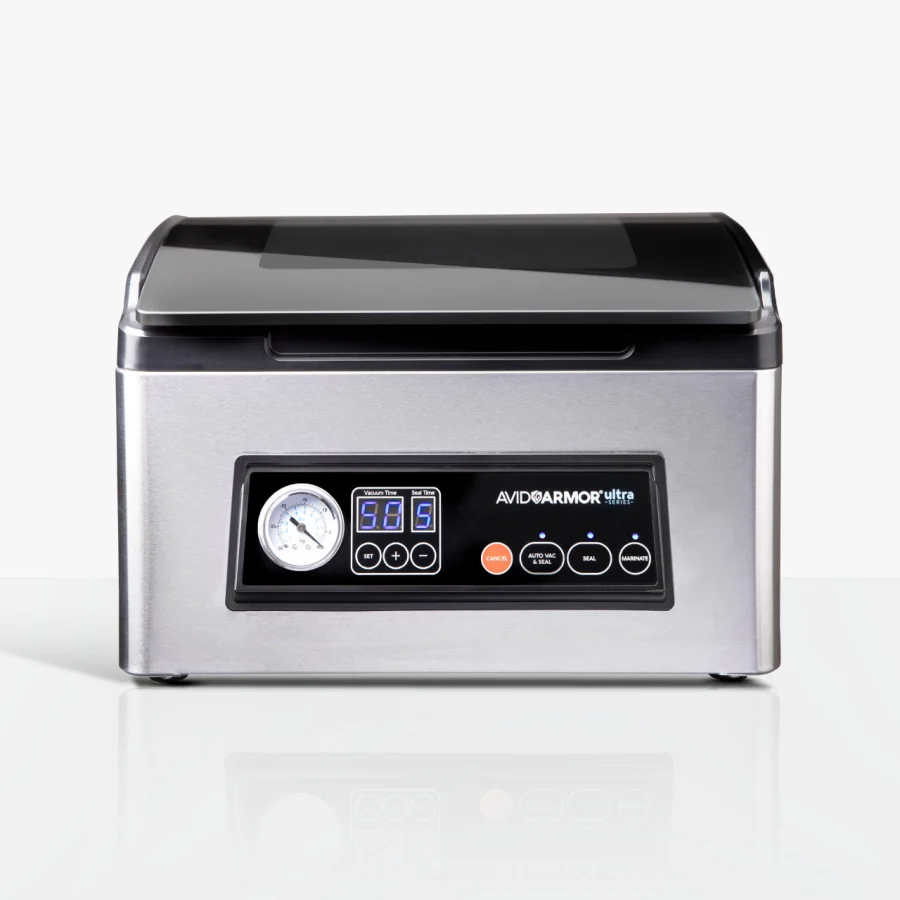
Choose the USV32 when the food’s length, rather than a desire for more settings, rules out the smaller models. Its supported flat pouch size reaches 11 × 13 inches. That offers a different packaging envelope from the USV20’s 11 × 10-inch format without moving to a much heavier commercial bench machine.
The compromise is visible in the workspace. Its 14 × 15.5 × 9.5-inch body weighs 26.4 pounds, and the open lid needs 22.5 inches of clearance. This is the model in the guide most likely to require a location away from a low wall cabinet. Treat it as an option that needs a planned home, not as the automatic upgrade because the number is larger.
We would accept that extra space when it prevents inconveniently dividing regular cuts or repeatedly switching equipment. We would stay with a smaller model when those longer pouches are only an occasional wish. Check the seller’s current offer before building a purchase around it; the brand’s own store currently shows this model as sold out. The USV20 versus USV32 guide helps weigh that capacity tradeoff.
Key Features
- Supported flat pouches up to 11 × 13 inches.
- Stainless-steel chamber and adjustable cycle settings.
- A 22.5-inch open-lid clearance requirement.
Pros
- Longer pouch formats within a household-oriented machine range.
- An alternative to buying a substantially heavier bench unit.
- Useful when package length is a recurring limitation.
Cons
- More depth, weight and overhead clearance to accommodate.
- Current supply needs checking with the selected seller.
- Larger pouches do not establish unlimited session capacity.
Quick Tips
- Measure one normal portion and your largest regular portion in suitable pouches.
- Reserve counter space for the open lid, bag loading and finished packages.
- Check the actual lifting route before planning cupboard storage.
- Choose controls around your routine, not the number of advertised modes.
- Compare ongoing pouch and maintenance costs after eliminating unsuitable sizes.
Measure the Working Space, Not Just the Appliance
Closed storage and open operation are different measurements
A shelf can accommodate the closed machine while the counter above it cannot accommodate the open lid. Write down both positions. Include cabinet trim, under-cabinet lights, the cord route and anything placed behind the appliance. When the lid clearance is close, obtain the exact opening diagram rather than estimating from a photograph.
Allow room for your hands and for positioning the pouch. A machine fitted tightly between other appliances may technically fit the counter but make each load awkward. The working area also needs a clean place for the next pouch and a separate place for completed packages. Keeping those spaces distinct reduces the temptation to stack food around the sealing position.
Storage height changes the handling decision
Moving a machine sideways across a stable counter is a different task from lifting it from floor level or reaching above shoulder height. Consider the user, shelf strength and grip points, not weight alone. A low closed height is not permission to store heavy equipment on a convenient-looking shelf.
If the only workable position requires repeated lifting you would rather avoid, compare a smaller machine or reconsider permanent placement. A slightly larger appliance that stays accessible can be more useful than a smaller one that is rarely retrieved. Our moving and storage guide covers the handling checks.
Decide Which Package Must Fit
Use the meal you regularly want to store as your reference. A pouch must wrap around the food, leave a clean neck and reach the required sealing position. Flat pouch dimensions describe film size, not the dimensions of a rigid container that will fit inside it.
Thickness matters as much as length. A broad, thin portion may use a wider mouth successfully while a narrower but taller portion presses toward the lid. Do not close a lid against a hard object to discover the limit. When a package is close to the boundary, ask for confirmation using its actual loaded shape.
Separate regular needs from exceptions. If a whole roast appears twice a year but most packages are individual servings, buying around that roast can create a daily space penalty. Conversely, repeatedly cutting the same food into unwanted pieces is a strong reason to choose another layout. The filled-pouch sizing worksheet helps turn that choice into measurements.
Choose Controls You Will Actually Use
Presets suit someone who prefers a small set of repeat choices. Timed controls suit someone who wants to record and revisit selected intervals. Automatic sensing reduces some selections, but the user still controls portioning, bag choice and package inspection. None of these interfaces makes the other buying decisions disappear.
For shared kitchens, think about whether another person can repeat the routine. A short note with pouch size, ordinary load and permitted settings is more useful than relying on memory. Keep separate notes when material or food changes substantially; a previous setting is a starting reference, not a universal recipe.
Additional cooking modes should earn their place through intended use. If you will never use infusion or compression, compare the ordinary loading and sealing process first. Paying for unused functions does not improve the fit of the appliance or the food.
Match the Machine to Your Weekly Batch
Count the packages you want to finish in one sitting. Making several meals on a weekend creates a different working pattern from sealing one or two portions after dinner. Annual use alone will not show that difference, even when the total bag count is similar.
Check the complete cycle and any required pauses before deciding that a compact dry-pump model can cover a larger preparation day. For example, LEM calls for a longer rest after 30 continuous seals on the 1745 and advises cooling between sealing cycles. Those requirements belong in the plan alongside filling and cleanup; they should not be discovered with a counter full of food waiting.
The useful comparison is whether the batch can be completed comfortably within the supported routine. If pauses fit naturally while you prepare the next food, a larger machine may add little. If the required workload repeatedly exceeds the intended use, reconsider the equipment size or split the preparation into manageable sessions with appropriate food storage.
Budget for Ownership Without Assuming Guaranteed Savings
Compare the delivered machine cost, suitable pouches, required consumables and any essential storage or support equipment. Do not treat an accessory bundle as a saving unless its contents replace things you would otherwise buy. A spare part is useful only when it matches the exact model.
Smooth chamber pouches can make an attractive consumable option, but lower film cost alone does not establish payback. Annual use, waste, maintenance and the value you place on convenience change the result. Our ownership-cost calculator lets you use your own figures instead of assuming the appliance will automatically save a fixed amount.
For a strict price ceiling, use the current retailer page after checking fit. Include shipping and the selected bundle. If no suitable machine meets the budget, waiting or continuing with existing equipment is a sound decision. A cheap machine that cannot package the food is still an expensive mistake.
Questions Before Choosing a Compact Chamber Sealer
Does a dry pump mean there is no maintenance?
No. A dry pump removes the oil reservoir and oil-change job, but the machine still has a lid gasket, sealing surface and wear parts. Remove food residue, inspect the gasket for debris or damage, and replace worn sealing consumables with matching parts. Batch limits remain separate: LEM’s dry-pump 1745, for example, needs a rest after 30 continuous seals. Pump type therefore simplifies one task without determining the whole maintenance routine.
Can I leave the machine beneath a wall cabinet?
The USV20 needs 17 inches of height with its lid open; the USV32 needs 22.5 inches. Measure from the counter to the lowest obstruction, including lighting and cabinet trim. If that gap is too small, the machine needs a different working position even when its closed body fits. Leave room in front to place a filled pouch without reaching around another appliance. Closed height alone is the wrong measurement for this decision.
Will a compact machine fit a family-sized roast?
The roast’s loaded width, length and height decide that, not its serving count. The USV1 supports flat pouches up to 10 × 10 inches, the USV20 up to 11 × 10, and the USV32 up to 11 × 13. Those are pouch limits, so allow for film wrapping around the meat and a clean neck. A long cut that must stay whole may suit an external sealer better than any shorter chamber.
Is more vacuum always the better buying criterion?
No. First decide whether the normal filled pouch fits and whether the machine can run the intended batch. Then compare pressure figures only when both use the same reference and comparable conditions. A gauge-pressure number and an absolute-pressure number can describe similar evacuation while looking very different. For delicate food, the ability to control the endpoint may matter more than the strongest advertised number. Our pressure guide explains the units.
What should I check when the machine arrives?
Before discarding the carton, check the model and voltage label, glass lid, hinges, gasket, supplied sealing parts and bundle contents. Photograph visible transit damage and report missing items within the seller’s stated window. Place the machine on its working surface and check that the lid opens and the filled pouch can be positioned comfortably. For an oil-pump unit, complete its oil setup before operation; for a dry model, adding oil is not part of startup.
Our Buying Recommendation
Start with the USV1 when smaller portions and storage access lead the decision. Move to the USV20 for its wider pouch opening and adjustable timing, or Anova for a cooking routine that will use its presets. Compare LEM and Vesta when their different layouts or removable components solve a specific problem. Choose the USV32 only when longer household pouches justify its larger working space. Let the package and the kitchen settle the decision before extra features do.
Sources
- Avid Armor USV1: dimensions, controls and pouch sizes
- Avid Armor USV20: specifications and supported pouches
- Anova Precision Chamber: specifications and functions
- LEM MaxVac Pro 1745: specifications
- Vesta V513 and V553: sizes and removable components
- Avid Armor USV32: dimensions and pouch sizes
- LEM chamber-sealer workshop: cooling and batch guidance