
Amazon links are affiliate links. As an Amazon Associate I earn from qualifying purchases. If you buy through these links, we may earn a commission at no extra cost to you. Affiliate disclosure.
The VacMaster VP210 vs VP215 choice is mainly a pump-maintenance decision between similarly sized chamber formats. Do not buy the VP215 assuming the model number automatically means a larger package will fit.
Investigate the VP210 when avoiding pump-oil service is important and its documented workload suits your session. Investigate the VP215 when its particular oil-pump ownership pattern fits your work and you can perform the approved maintenance.
What the manufacturer records establish
| Decision point | VP210 | VP215 |
|---|---|---|
| Pump design | Dry piston design | Rotary oil design |
| Published chamber in the referenced documents | 11.25 × 15.25 × 5 inches | 11.25 × 15.25 × 5 inches |
| Pump-oil service | Not the documented dry-pump routine | Required model-specific routine |
| Capacity implication | Check loaded package and permitted pouch | Do not assume larger capacity than VP210 |
| Purchase record | Match current product and manual | Match support documents and actual revision |
Compare the exact model and bundle on Amazon. Confirm the selected seller, included items, warranty and delivery before ordering.
Sources: the manufacturer comparison, current VP210 record and VP215 specification sheet. Matching chamber dimensions do not establish identical internal shapes or all accessories; confirm the actual loading arrangement.
Begin with package fit for either machine
Use the same representative portion and intended pouch for both. Confirm the maximum supported mouth width, clean neck and placement at the seal assembly.
If the package fails the supported arrangement on one machine, ask whether the other actually changes that constraint. A different pump cannot make a long food item shorter or widen a sealing assembly.
Use our sizing worksheet before paying for an assumed upgrade. Compare a larger chamber model or suitable external equipment if the real requirement is length or width.
Why seal-bar figures need a revision check
The current VP210 product page describes a 10-inch bar, while its June 2024 manual gives a 10.25-inch figure. That difference should be retained as a source conflict rather than silently rounded into a definitive specification.
The VP215 support-linked sheet also has its own stated dimensions and date context. Do not combine the most favorable number from each document into a single current-machine table.
For purchase fit, obtain the supported pouch limit and the correct revision from the manufacturer. A nominal quarter-inch bar difference is not a useful advantage if the approved bag envelope is unchanged.
What the dry pump changes
The VP210’s documented pump avoids pump-oil changes. That can suit an owner who wants a bench machine but does not want an oil service task.
It does not mean the complete appliance never needs attention. Chamber cleaning, gasket condition, sealing consumables and supported operation still matter. Identify replacement parts and the service route before purchase.
Also check intended use and duty guidance. The absence of pump oil is not a category-wide continuous-duty rating.
What the oil pump changes
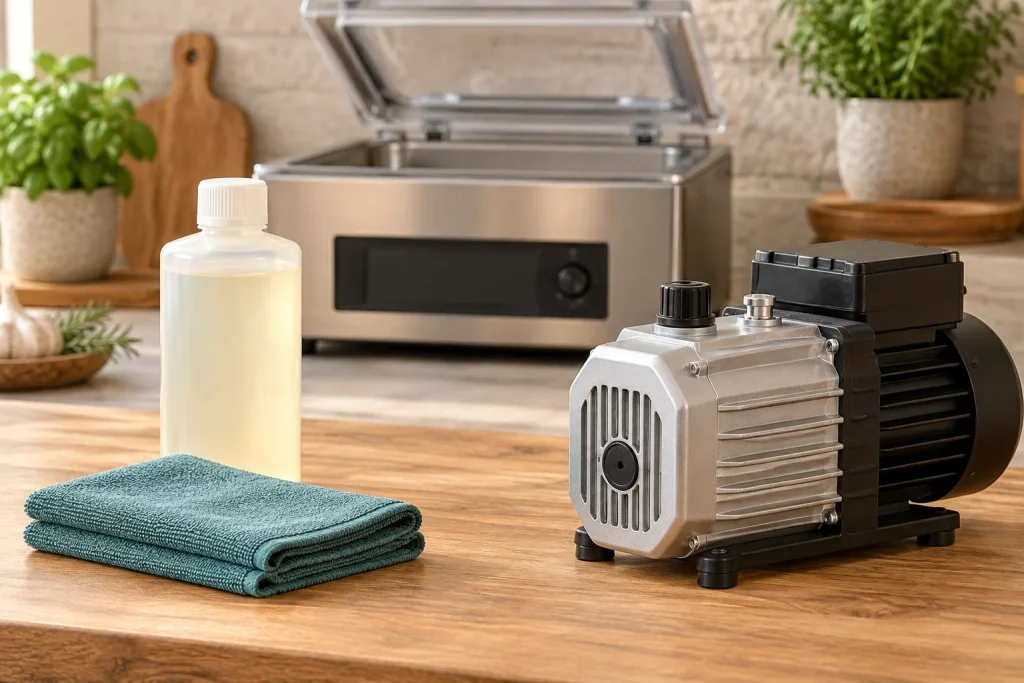
For the VP215, obtain the exact oil, initial setup, level check and change instructions applicable to the unit. Keep an operating and service record.
Do not replace those requirements with the vague idea of changing oil a couple of times a year. Different official records may express maintenance by use, condition or schedule. Match the manual and ask support to resolve conflicts.
The oil-maintenance guide explains the record to keep. The service obligation is real ownership work, even when a seller presents the machine as easy to operate.
Performance claims and what we can conclude
VacMaster’s model-comparison FAQ says the VP215 can evacuate somewhat faster and describes smoother, quieter operation. Those are manufacturer claims for these models, not our measured findings.
Complete-session throughput depends on loading, sealing, cooling, venting and required pauses. Compare the whole session rather than treating a pump-speed claim as a bags-per-hour guarantee.
If a small timing difference would determine the purchase, obtain comparable current evidence or arrange a demonstration. If it would not change your ordinary household session meaningfully, maintenance and handling may deserve greater weight.
Plan them as bench equipment
Use the actual weight and dimensions for the selected revision to plan lifting, a stable work surface and service access. A product being called countertop does not mean every kitchen shelf or cart is suitable.
Check open-lid room and a place to fill and inspect bags. Include any required clearance and power-supply conditions. Do not assume an adapter or extension lead resolves an unsuitable installation.
Read the manual’s transport orientation, especially for oil-equipped equipment. Our moving and storage guide covers the questions to resolve without prescribing one method for every pump.
Consumables and costs
Compare appropriate pouches for equivalent portions. Add sealing parts and any oil service to ownership assumptions. Do not assign an extra lifespan to the VP215 simply because it has oil, or a zero repair cost to the VP210 because its pump is described as maintenance-free.
Separate a new-purchase comparison from replacing a machine you already own. The ownership worksheet provides a transparent way to test the incremental cost.
Check the selected seller, voltage, bundle, returns and warranty eligibility. A manufacturer catalog entry does not establish current delivery availability or coverage from every marketplace seller.
Which buyer should investigate each?
The VP210 is a sensible candidate to investigate when its supported package and workload fit and avoiding oil service is a firm preference. Do not reject that fit because another model has a higher number.
The VP215 is a sensible candidate when its documented operating requirements suit your work and you can maintain it. Do not choose it as a capacity upgrade unless current exact-model evidence shows the particular fit difference you need.
If either machine’s installation would be awkward for occasional use, compare a lighter compact option. If both fail the package, compare another format. There is no obligation to choose between two unsuitable machines.
Questions buyers ask
Does the VP215 hold larger bags?
No capacity increase follows from this pump change. Both models list a maximum 10 × 13-inch chamber-pouch format. Choose VP215 for the oil-pump ownership and workload proposition, or VP210 to avoid oil changes; neither gives a long cut extra room just because its model number differs.
Is the VP215 quieter?
VacMaster describes smoother, quieter operation in its comparison with VP210. That is a model-specific manufacturer claim, not a published matched decibel test in this article. If noise will decide the purchase, request a demonstration or comparable sound measurements at the same distance and operating stage.
Can I ignore oil service with light use?
No. VacMaster’s general oil FAQ gives a first change at 25 operating hours, then every 60, with an earlier change for dark-brown or milky oil. Track hours and condition separately. An applicable storage requirement can also matter between seasons, so low annual bag count is not a reason to leave contaminated oil in the pump.
Our conclusion
Resolve fit first. If both models suit the same portions and workspace, choose the maintenance and documented operating pattern that fits your routine. Keep manufacturer performance claims attributed and current-document conflicts visible until resolved.