
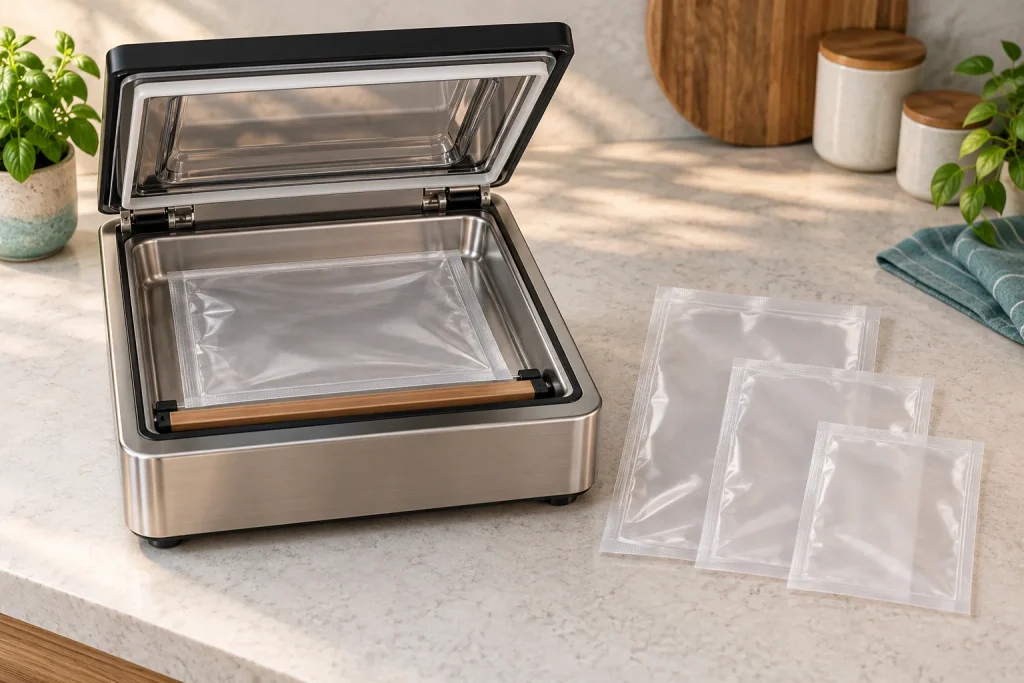
The bags that fit the Avid Armor USV20 start with the manufacturer’s supported sizes: 6 × 8, 6 × 10, 8 × 10, 10 × 10 and 11 × 10 inches. Choose among them by your filled portion and the opening orientation, not simply by selecting the largest bag.
These are the sizes in Avid Armor’s Ultra Series pouch guide, checked on 30 October 2026. They describe supported empty pouches. They do not mean a rigid food item of the same dimensions will fit inside the bag or chamber.
Supported sizes and practical selection
| Listed pouch | A useful starting question |
|---|---|
| 6 × 8 inches | Does this hold the small portion with enough clean opening space? |
| 6 × 10 inches | Does the added length suit the same narrower portion? |
| 8 × 10 inches | Does the filled width sit naturally in the approved position? |
| 10 × 10 inches | Does the broader package need the extra material? |
| 11 × 10 inches | Is the wide opening correctly oriented for the maximum supported envelope? |
Use the questions to check the filled package rather than assign a food weight to an empty pouch.
Why 11 × 10 can be confusing
The USV20’s model support information identifies an 11-inch maximum sealing width. With the manufacturer’s 11 × 10 envelope-style pouch, the opening is on the wide edge rather than an assumed longer dimension running away from the bar.
Before ordering an equivalent third-party size, confirm which edge opens. A superficially similar 10 × 11 description may use a different dimension convention or opening. Ask for a diagram or an actual pouch sample when the listing is ambiguous.
Do not try to obtain extra length by rotating a bag so its opening cannot lie correctly across the seal bar. The air path and sealing position are part of compatibility, not optional arrangements.
The loaded portion uses the flat dimensions
A pouch wraps around the food’s thickness. Its side seals and clean neck also occupy space. The maximum flat size therefore cannot be interpreted as a solid rectangular chamber load of the same width and length.
Test a representative portion in the intended pouch. Lay the opening as the USV20 instructions require, without stretching the film or pushing food into the sealing area. Check the load height and the lid’s path as well as the footprint.
Our general size guide provides a worksheet. For a close fit, ask the manufacturer to confirm the arrangement rather than using the lid as a clearance test.
Smooth or embossed material?
The maker permits regular vacuum-sealer bags in the USV20 and recommends chamber pouches as the economical approach. That does not remove the need to verify width, thickness, filled fit and intended food use.
Smooth chamber pouches are a logical starting point for normal chamber work. Existing embossed material may have a role when allowed by the instructions, but it should not be mistaken for proof of a stronger package or a cooking rating.
The smooth-versus-embossed guide explains the construction difference. If you intend to use the machine externally, check that mode’s separate bag requirements rather than applying the chamber list automatically.
Buy a useful size mix
List your most common portions before ordering a variety pack. Count how many of each size you would use in a typical month. A low nominal price is less useful when most of the pack is a size you rarely need.
For example, if your routine consists of several small portions and one larger weekly package, a pack dominated by the largest size may increase material waste. Conversely, a small-bag assortment is poor value if you repeatedly need two bags or awkwardly divided portions.
Start with a modest quantity when the shape or supplier is new. Retain the pack label and specification record so a later reorder is genuinely the same product.
Check these details on a third-party listing
Confirm the opening edge, outside dimensions, usable inside dimensions if supplied, construction, stated thickness and whether thickness describes one wall or the whole package. Verify that the seller identifies chamber-machine use where appropriate.
Then verify the intended application. Freezing and cooking are different questions. Do not infer a suitable temperature and duration from the phrase “food grade” or from the material merely fitting the machine.
See cooking ratings and the pouch buying guide for those additional checks. Neither the brand name nor a “universal” claim overrides the exact specification.
Loading and inspection
Follow the USV20 operating sequence for positioning the mouth and using the clamp. Keep the opening clean and flat. Make sure the bag is not pinched in a way that prevents evacuation and is not caught in the lid gasket.
Inspect the finished seal after the cycle completes. If a supported bag repeatedly inflates, shifts or leaves a poor result, check placement and the correct settings before assuming the pouch size is unsupported.
Change one factor at a time: pouch supplier, load, positioning or selected setting. A small log can reveal whether a problem follows a particular material or simply a crowded load.
When a longer bag is needed
If your regular portion exceeds the supported chamber arrangement, consider a different approved package or equipment. Do not fold an oversized load under the lid or extend a smooth bag through the chamber boundary as an improvised method.
Avid Armor separately documents external bag use for the USV20. That mode requires its own process and textured material; it is not an extension of the smooth-pouch size table. Our oversized-item guide explains the distinction.
If larger portions are routine rather than occasional, read the USV20 versus USV32 comparison before committing to a bulk bag purchase.
Questions about USV20 bags
Is 11 × 10 the food capacity?
No. It describes a flat pouch with an 11-inch opening and 10-inch length. Food thickness uses some width as the film wraps around it, and part of the length must remain clean for sealing. Check a filled portion rather than treating those numbers as the dimensions of a rigid food container.
Can I cut a large pouch smaller?
Trimming the open end reduces length but leaves less clean neck for the final seam. Cutting a sealed edge creates another opening that must be closed soundly with compatible heat-sealable film. For a repeat smaller portion, an appropriately sized precut pouch usually saves that extra seam and handling.
Does every 11-inch roll fit?
No. Check which edge becomes the opening, whether the film is smooth or textured, and the final cut length. A roll also needs a bottom seam. USV20’s supported 11 × 10-inch flat format does not turn an arbitrarily long piece of 11-inch roll into a chamber-fitting package.
Should I buy the largest size for everything?
Use the smallest supported size that comfortably wraps the normal portion and leaves a clean neck. Keep a second larger format for food that needs it. One large bag can simplify ordering while using unnecessary film and freezer space for every small package.
Choose the pouch around your routine
Use the supported list as the first filter, confirm the opening edge, and test filled fit before ordering a large pack. The right size makes loading easier and avoids paying for material that contributes nothing to the package.