
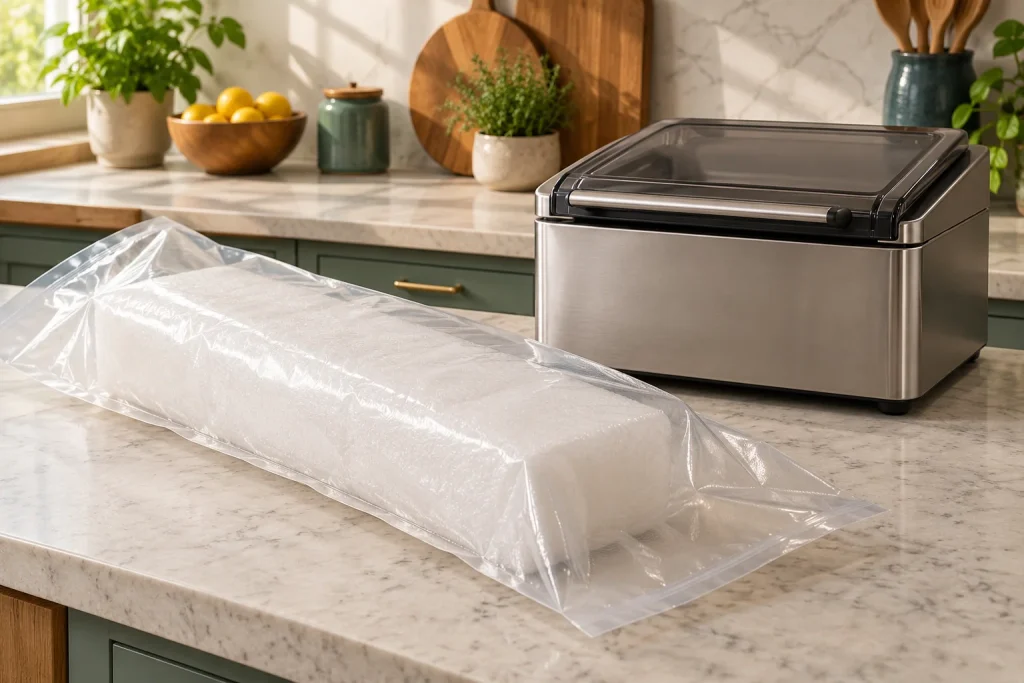
Can a chamber vacuum sealer seal bags externally? Some models have a documented external-bag method, but you must verify the exact machine and material. An accessory port for canisters does not, by itself, establish that capability.
For the USV20, Avid Armor’s external-use guidance permits an embossed or textured bag outside the chamber and specifically excludes liquids in that arrangement. This is a model-specific function, not a rule for every chamber machine.
Separate three capabilities
| Capability | What is being evacuated | What to verify |
|---|---|---|
| Ordinary chamber cycle | Package inside the chamber | Supported pouch and loaded fit |
| External container via hose | Compatible canister, jar system or other approved vessel | Port, hose, adapter and vessel |
| External bag method | Bag with food outside the chamber | Explicit machine instructions, bag construction and placement |
A seller may mention “external vacuum” while describing only containers. Ask which of these jobs the model supports before buying it for long packages.
Why bag construction changes
Ordinary chamber packaging reduces pressure around the pouch as well as inside it. An external arrangement instead needs the air path required by that machine’s suction method.
For the documented USV20 method, textured material is part of the instructions. Do not assume a smooth chamber pouch will work merely because its mouth fits across the bar.
Our smooth-versus-embossed guide explains that difference. Material construction, heat-seal compatibility and package dimensions all remain necessary checks.
Confirm the method before preparing food
Find an explicit instruction or manufacturer demonstration for the exact model. Match the physical controls and revision. Do not substitute a video for another Ultra Series machine simply because the lids look similar.
Check the permitted bag width, opening position, cycle and stop controls. Confirm whether a clamp or sealing assembly has to be arranged differently and what the manufacturer allows as owner setup.
If the maker only documents external canisters, treat external bag use as unconfirmed. Do not invent a loading arrangement from the shape of the chamber gasket.
A preparation sequence that stays within the instructions
First establish that the specific machine supports the job. Second choose the specified compatible bag construction. Third confirm the finished package and clean opening can be supported stably. Fourth follow the model’s exact placement and operating sequence. Finally inspect the complete package after normal cycle release.
Use the exact model’s diagram for the bag mouth. Placement is design-specific; these planning steps do not authorize an alternative arrangement.
Never force the lid, defeat an interlock or trap material through a gasket boundary unless that is the manufacturer’s explicitly approved method. The lid needs to operate as designed.
Support the package outside the machine
A long or heavy package needs a stable surface at an appropriate position. Avoid a bag hanging from its mouth or pulling the opening away from the sealing area.
Use a clean support suitable for the food-handling arrangement. Keep the machine stable and preserve required clearance and cord access. A makeshift platform should not introduce tipping, obstruction or a contamination problem.
If the package cannot be positioned comfortably, another machine or portion format may be more appropriate. External capability is not a promise of unlimited package size.
Keep liquids out of an unapproved external process
Do not transfer chamber liquid capability to the outside-bag arrangement. The cited USV20 instructions expressly say liquids cannot be sealed externally.
For other models, use their own approved wet-food instructions. Do not interpret “moist” on a control as permission for a bag containing free liquid. A spill or ingestion event can require manufacturer service rather than ordinary wiping.
The liquid operating guide addresses ordinary chamber loading. It is not an authorization for external liquid packaging.
Count both seams if you use rolls
Compatible roll material needs a bottom seam to make a bag. Verify that the machine supports the required preparation process, then inspect that seam and the final closure.
Include the extra material and machine cycles when comparing cost or workload. A longer package can solve a fit problem without being the cheapest package or the fastest session.
Our rolls-versus-precut guide shows how to calculate equivalent finished-package cost without making a universal savings claim.
Inspect the result and record the setup
Check for folds, contamination, damaged film and incomplete seam ends. A bag that looks tight immediately can still have a later puncture or seam defect, so do not treat the first appearance as a storage-life test.
Record the material, supplier, size, settings and any difficulty holding the opening in place. If repeated failures follow the arrangement, stop and ask the manufacturer rather than increasing settings indefinitely.
The troubleshooting hub helps distinguish poor evacuation from heat-seal and later-puncture issues.
When a dedicated external sealer may be simpler
If long packages dominate your routine, investigate equipment designed around that format. A documented secondary function can be useful occasionally while still being awkward as your main workflow.
Compare the complete setup: supported bag, package support, handling, approved workload, cleaning and storage. Do not buy a compact chamber primarily for a secondary mode you have not confirmed.
Our chamber-versus-external comparison starts with that purchasing question. Keeping an existing appropriate external machine can also be reasonable.
Questions owners ask
Does an accessory hose mean I can seal an outside bag?
No. A hose removes air through a port on a compatible container. An outside bag needs its own supported mouth placement, evacuation path and sealing sequence. Check for explicit external-bag capability rather than using a jar attachment as evidence that the machine supports both functions.
Can I use smooth material if I make it longer?
Extra length does not create the air channels used by an ordinary external suction method. Use the construction specified for that supported mode, often textured film. A bag can reach the bar and receive a heat seam while failing to evacuate properly; those are separate results.
Can I use it for soup outside the chamber?
The USV20 external-bag method excludes liquids. In external suction sealing, free liquid can move toward the intake instead of remaining in a supported chamber arrangement. Use chamber loading for compatible liquid pouches; an outside-bag mode is mainly an answer to package geometry, not a general replacement for liquid chamber use.
Does outside use remove the bag-width limit?
No. The open mouth still has to fit the supported sealing arrangement. External placement can solve a package-length problem because the food sits outside the chamber. It does not lengthen the seal bar or make a wider pouch opening usable.
Confirm the capability, then use it narrowly
External bag use can be a useful model-specific option for an oversized package. Verify it explicitly, use the required material and support the load correctly. If the job depends on an improvised arrangement, choose a better-supported process instead.