
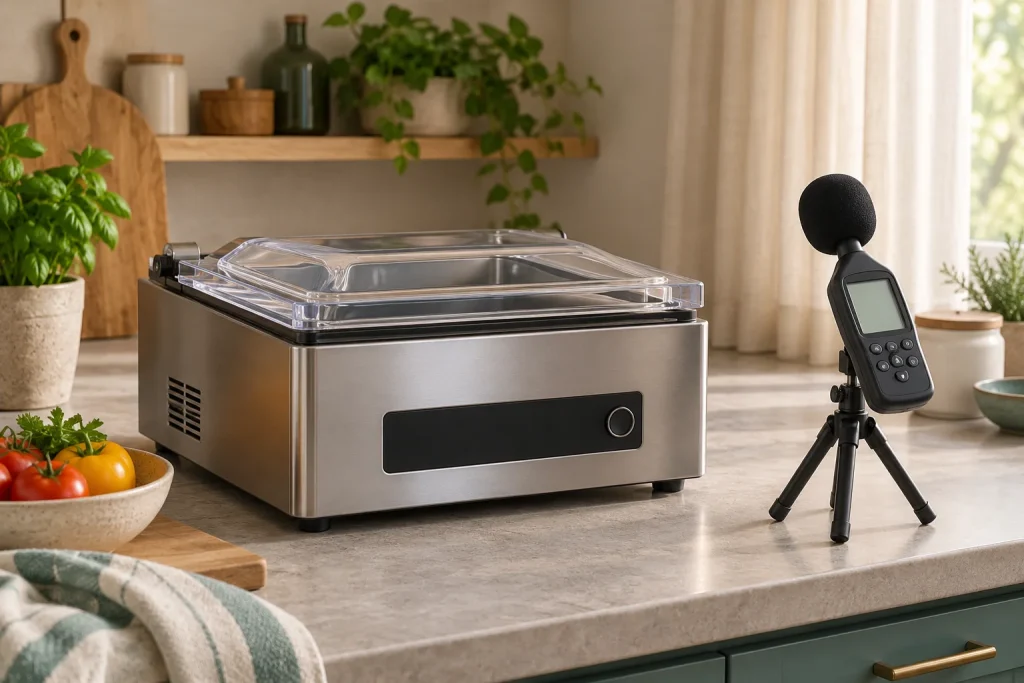
Chamber vacuum sealer noise depends on the exact machine, operating stage, room, distance and measurement method. Compare measurements made under the same conditions before choosing a quieter model.
A useful buying comparison needs matched evidence. An unqualified quiet label, a phone recording and a sound-level measurement taken at an unknown distance cannot be ranked as though they were equivalent.
Ask what the number describes
| Measurement detail | Why it matters |
|---|---|
| Exact model and revision | Similar machines can differ |
| Distance and microphone position | Position changes the comparison |
| Room and background sound | Other sound and reflections contribute |
| Operating stage | Pumping, sealing, venting and standby are different |
| Metric and weighting | An average, maximum and peak are not interchangeable |
| Instrument and calibration | Equipment limits affect confidence |
| Load and settings | A different cycle can change the session |
A number without these details may still be a seller’s claim, but it is weak evidence for choosing the quietest machine.
Compare stages, not only a short clip
A cycle can contain different sounds and durations. A brief recording may show the start of pumping while omitting venting or continued fan operation.
Record the complete cycle and note when each stage occurs. Also identify whether the measurement includes idle time or just the active vacuum interval.
Do not assume an oil pump always sounds quieter than a dry pump. A manufacturer may make a specific comparison between its own models, but that is not a measured category-wide rule.
A practical home-comparison method
Use the same suitable room, stable surface, microphone position, machine settings and comparable load. Measure background sound before running the machine. Keep the manufacturer’s ventilation clear and do not change approved operation to make the unit sound better.
Choose and document a distance, such as a self-selected one-meter position if practical. That is a repeatable home method, not a claim to follow a formal appliance sound standard.
Record several comparable cycles, the full duration and any required rests. A single unusually quiet segment should not represent the entire appliance.
Select a metric deliberately
A full-cycle equivalent level and a maximum can answer different questions. Keep the weighting and time basis with the value rather than publishing an unexplained dB number.
Decibels are logarithmic, so do not calculate an ordinary arithmetic average of several displayed readings and call it a properly integrated sound average. Use the instrument’s appropriate recorded metric and document its scope.
If you only have a basic display or recording, describe that limitation honestly. A useful observation does not need to pretend to be a laboratory measurement.
What a phone app can contribute
CDC NIOSH’s sound-level app documentation describes an iOS tool, its metrics and validation conditions, including the role of a calibrated external microphone. That is a credible starting reference for understanding measurement limits.
Do not generalize its stated accuracy to every phone, accessory or unrelated app. A phone comparison may be useful for a consistent setup while still having limitations for absolute values or small differences.
Record device, app, microphone, calibration arrangement and settings. Avoid claiming a minor advantage when it is too small relative to the method’s uncertainty.
Audio is useful for character, with caveats
A recording can help describe a hum, rattle or abrupt stage change. It does not reliably let listeners compare absolute loudness when recording gain, distance, compression and playback level differ.
If you share audio, keep the setup and recording settings consistent and describe them. Do not normalize one recording differently to make a candidate appear quieter.
Placement can change the household experience
Consider where the appliance will operate and what the surface or surrounding room contributes. Use a stable installation that follows the manufacturer’s instructions.
Do not enclose vents, add unapproved padding or cover the machine while running to reduce sound. A placement experiment should not compromise supported operation.
Also consider duration and schedule. A slightly different measured level may matter less to your household than the complete session length or the location of the workstation. Describe those practical constraints separately from a noise ranking.
New noise is a maintenance question
A change in sound, especially with abnormal operation or a known spill or move, should be investigated through the correct support route. Do not label every rattle a worn pump or silence it with a modified enclosure.
Record the stage, settings, load and when the change began. A short safe recording may help support, but do not operate visibly damaged equipment merely to collect it.
The troubleshooting hub helps organize observations without inventing an internal diagnosis.
What a useful review should publish
Identify the models, method, repeated results and limitations. Distinguish manufacturer claims from measured values and keep stage or full-cycle metrics consistent.
If the evidence is unavailable, state that noise remains unmeasured. That is more useful than a quietest award derived from the word quiet in a listing.
Our pump comparison follows that principle instead of assigning sound performance by lubrication type.
Questions buyers ask
Can I compare two videos by ear?
Use videos to notice sound character, such as a rattle or abrupt vent, rather than rank absolute loudness. Microphone distance, automatic gain, room reflections and playback volume can change what you hear. A useful noise comparison needs the same recording and measurement conditions for both machines.
Is one meter the official test distance?
One meter is a possible fixed home-comparison distance, not a universal certification method. State the distance and keep it the same for both machines, together with the room, microphone position, load and cycle stage. A formal rating must name its actual measurement standard.
Does a lower displayed number always win?
Compare the same sound metric first: a whole-cycle average and a brief peak describe different things. Keep distance, settings and background noise consistent. A small difference measured in unlike rooms or with unlike phone positions is not a reliable basis for choosing the quieter machine.
Ask for comparable evidence
Before choosing a sealer mainly for noise, seek a clearly documented measurement or demonstration. Keep the complete cycle, room and household routine in view. Without that evidence, retain noise as an open purchase question rather than inventing precision.