
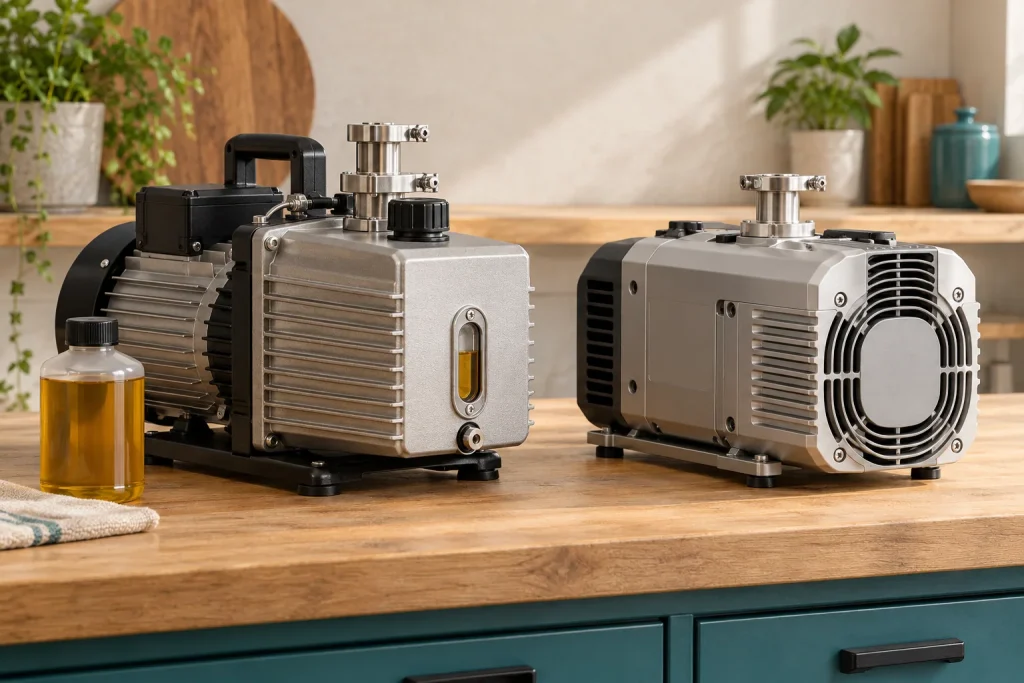
The chamber vacuum sealer oil pump vs dry pump decision is mainly an ownership and workload question. A dry-pump design avoids routine pump-oil changes. An oil-pump machine introduces model-specific oil maintenance that may be acceptable for the work it is designed to do.
Neither category guarantees a particular speed, noise level, lifespan or duty cycle. Choose between actual machines with documented limits, not between two broad labels.
The useful distinctions
| Question | Dry-pump machine | Oil-pump machine |
|---|---|---|
| Pump-oil routine | No pump-oil change for the documented dry design | Oil type, level, condition and change instructions matter |
| Other upkeep | Cleaning, seals and parts still require attention | Cleaning, seals and parts still require attention |
| Suitable workload | Must be established for the exact model | Must be established for the exact model |
| Moisture response | Follow the manufacturer’s operating limits | Follow the manufacturer’s oil and vapor guidance |
| Service planning | Identify available parts and support | Identify available parts, support and approved oil |
| Performance conclusion | Cannot infer from category alone | Cannot infer from category alone |
This is a decision matrix, not a claim that all machines in a category share the same internal design.
A useful named-model example
VacMaster’s VP210-versus-VP215 support page identifies a maintenance-free piston pump in the VP210 and a rotary oil pump in the VP215. It also makes model-specific comparative performance claims.
VacMaster’s comparison applies to those models. Do not turn it into a rule that every oil-pump sealer is quieter or faster than every dry-pump model.
The practical buying question is whether the VP215’s documented work pattern and service needs suit you better than the VP210’s. Our VP210 versus VP215 comparison considers that choice separately.
What oil maintenance adds to ownership
Obtain the exact approved oil, initial-fill instructions, level-check method and change schedule before purchase. Ask whether an owner can perform the service and what access it requires.
A machine requiring oil does not necessarily arrive ready to run with the correct level. Follow its setup instructions. Do not borrow a fill volume from a similar-looking model or assume the entire supplied bottle belongs in the pump.
Keep a dated service log. If the schedule is expressed in operating hours, track the relevant use rather than estimating from how many months the machine has stood in the kitchen. Condition-based instructions can require action before a calendar interval.
Dispose of used oil according to applicable local arrangements. Include the consumable and service inconvenience in the purchase calculation. The oil-maintenance guide explains why model-specific records matter.
What a dry pump does not remove
A dry design avoids its pump-oil task. It does not make the lid gasket, sealing surface, heat element, cooling system or chamber immune to wear and residue.
For example, the current USV20 is documented as a dry-pump machine, but its support information still addresses sealing components and operating symptoms. Read “maintenance-free pump” in that context rather than treating the entire appliance as service-free.
Ask how you would obtain the correct gasket and sealing consumables. Good documentation and support can matter more to useful ownership than a broad category promise.
Compare the whole session
Write down your normal batch: portions, bag sizes, wet or dry loads and successful packages needed. Then obtain complete-cycle and rest guidance for the exact candidates.
A larger pump rating may not translate directly into your finished-package rate. Filling, loading, heat sealing, cooling, venting and inspection all consume time. The allowed session limit can matter more than a small difference during evacuation.
If you cannot obtain a documented workload suitable for your session, do not assume an oil pump solves the information gap. Equally, do not reject a dry-pump model that explicitly supports your modest household batch.
Our duty-cycle article provides a session worksheet. It keeps cooling requirements separate from lubrication.
Moisture and contamination need specific instructions
Wet-food packaging does not mean liquid is permitted inside the pump. A spill, vapor exposure and normal surface residue are different conditions.
Ask what the manufacturer allows and how it instructs owners to respond to suspected contamination. An oil change or conditioning program is not a universal cure for every internal problem.
If oil appears abnormal, stop and follow the exact model’s inspection or service process. Do not diagnose the cause solely from a photograph. If liquid entered an uncertain path, explain the event to support before running more cycles.
The conditioning guide addresses those limits without prescribing one treatment for every design.
Noise and placement
Do not compare “quiet” in one advertisement with a decibel figure measured under unknown conditions for another machine. Distance, room, operating stage and the measurement method can alter the comparison.
If noise determines whether the appliance can be used in your home, seek comparable evidence or arrange a demonstration. Until then, describe noise as unmeasured rather than assigning a winner by pump category.
Also compare weight, carrying and storage. An oil-pump machine may require orientation precautions that affect a cupboard or transport plan. Read its handling instructions before treating a smaller footprint as proof that storage is easy.
A simple choice by routine
For occasional household work, a supported dry-pump machine may offer the upkeep pattern you prefer. Confirm that the packages fit and the workload is documented; convenience does not compensate for inadequate capacity.
For regular batches that justify a particular oil-pump machine, the service routine may be a reasonable tradeoff. Be willing and able to perform the approved checks, and provide a stable location where the machine can be used and serviced.
If you will not maintain an oil-pump model, do not choose it on the assumption that the task can be ignored. If a dry model cannot support your work, do not choose it solely to avoid maintenance. Compare another candidate.
Model-specific evidence checklist
Before deciding, obtain the exact manual, pump design, approved workload, supported pouch envelope, cleaning instructions, service parts and warranty policy. For an oil machine, add oil and orientation requirements. For either, record unresolved conflicts.
Do not transform older source figures into current specifications without a revision check. VacMaster’s VP215 support page links documents with different dates; identify which applies to the unit offered.
Common questions
Are oil pumps always stronger?
Pump lubrication and pressure performance are different specifications. Compare actual models using the same pressure reference and a meaningful complete-cycle workload. An oil-pump design can suit demanding sessions while adding oil upkeep, but that does not make every oil machine a stronger or faster choice than every dry-pump alternative.
Are dry pumps cheaper to own?
They avoid oil purchases and changes, but total cost also includes equipment price, bags, sealing consumables and service. A lightly used owner may value avoiding the service task more than the small oil cost. Compare those costs at the same annual package count rather than pricing the pump category alone.
Can I convert one type to the other?
Treat that as a machine redesign, not a normal owner upgrade. Pump mounting, electrical demand, control timing and the vacuum plumbing work as a system. Changing only the pump can leave those parts mismatched. Buying a supported oil- or dry-pump model is the practical comparison unless the maker supplies an approved conversion.
Choose the obligation you can support
Match the machine to your packages and session, then accept the maintenance routine it actually requires. Oil versus dry is a useful filter when it clarifies ownership. It becomes misleading when used as a substitute for model-specific performance and duty evidence.