
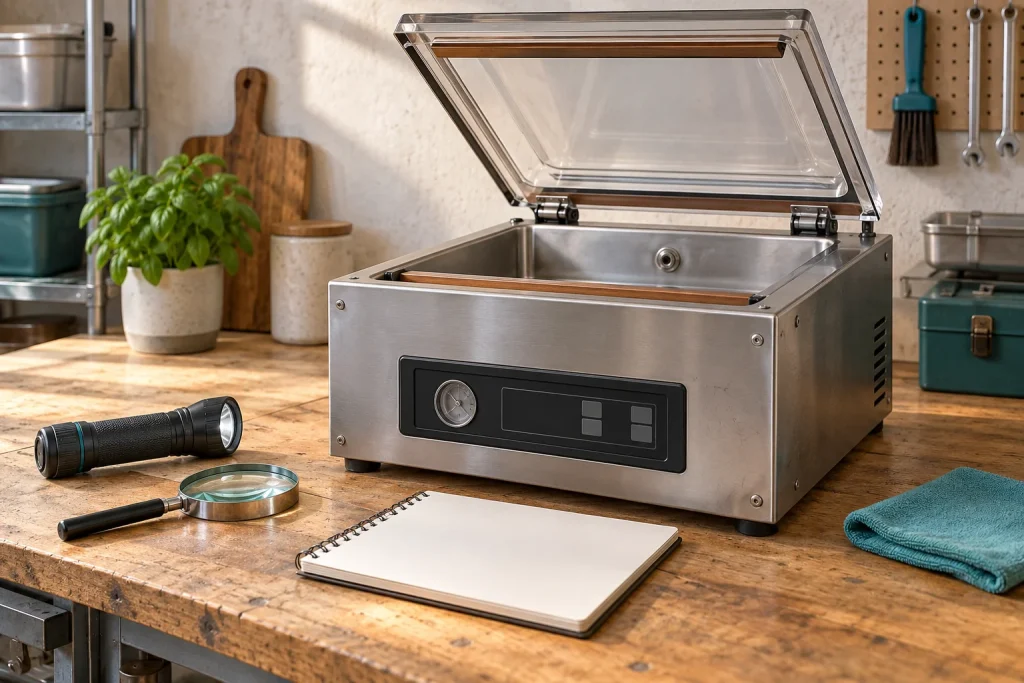
Buying a used chamber vacuum sealer can make sense when you can identify the exact machine, assess its condition and support, and account for transport and likely service. A low asking price alone does not establish value.
Start with a suitable model for your own portions and workspace. A bargain on the wrong size or an unsupported electrical version is still the wrong purchase. This checklist organizes research and inspection; it does not certify the remaining life or safety of an individual used unit.
Collect the identity record first
Ask for the brand, full model, revision or serial, electrical label, approximate purchase date and the applicable manual. Obtain clear photographs without asking the seller to dismantle or operate exposed equipment.
Match the model to manufacturer records. A similar appearance or abbreviated listing title is insufficient, particularly in families with dry and oil-pump versions.
Our model-identification guide helps prevent buying a machine whose specifications belong to another revision. If identity remains unclear, keep that uncertainty in the decision rather than assigning an attractive specification by guesswork.
Ask about the operating history
Request the normal workload, foods packaged, maintenance record, known spills, repairs, storage conditions and reason for sale. Receipts and service records are more useful than “barely used” without context.
An operating-hour or cycle counter can help where present, but ask what it measures and whether it is complete. A clean exterior does not establish internal pump condition, and a replacement part does not establish the condition of the rest of the machine.
Do not assume heavy use means a machine is exhausted or light use means it is healthy. Evaluate the actual evidence and get qualified assessment when needed.
Inspect accessible condition safely
| Area | What to establish |
|---|---|
| Lid | No unexplained crack, damage or unsupported repair |
| Cord and plug | Correct supply version and no visible damage |
| Chamber and exterior | Condition consistent with the stated history |
| Gasket and sealing interface | Correct parts, seating and visible wear |
| Controls | Documented functions operate as intended |
| Oil system, if applicable | Correct service record and permitted level/condition check |
| Included accessories | Actual part identities and compatibility |
Do not test a damaged lid, cord or abnormal machine by running another cycle. A possible defect should be assessed through the appropriate service route.
Arrange a meaningful demonstration
Use the actual matching manual, a compatible pouch and an appropriate representative non-food load where the instructions permit. Observe startup, normal cycle completion, venting and the finished seam.
A demonstration should answer specific questions. Does the machine complete the documented process? Is the opening positioned correctly? Are there visible seam defects or abnormal behavior?
One successful package does not establish a low long-term failure rate, complete duty capacity or remaining lifespan. Treat it as limited evidence. A seller declining a demonstration is not proof of a fault, but it leaves the purchase less certain.
Confirm parts and service before agreeing a price
Identify the actual gasket, sealing consumables and other likely service parts. Ask the manufacturer or supported supplier whether the revision is still serviced and whether the relevant part numbers remain available.
A manual with an exploded diagram does not guarantee current stock or an affordable repair. A generic kit may fit only some revisions.
Use the parts guide to ask precise questions. For an oil model, also establish the approved oil and maintenance routine rather than assuming a quick change repairs all unknown history.
Warranty is not automatic
Ask whether any manufacturer coverage remains and whether it applies after transfer, through the particular seller and in your country. Do not accept the original warranty length as evidence that a used purchase is covered.
Policies differ. Anova’s vacuum-sealer terms, for example, include transfer and as-is exclusions within their stated scope. That example is a reason to check the exact model’s policy, not a universal rule about every used sealer.
A seller warranty or refurbished program is another agreement with its own provider and limits. Record it separately from manufacturer coverage.
Calculate the complete used cost
Add purchase price, collection or delivery, lifting or work-surface costs, known consumables, confirmed repairs and a clearly labeled uncertainty allowance.
For a hypothetical example, a $400 machine with $100 transport, $150 known service and a $100 personal reserve totals $750. These are hypothetical amounts. Replace them with the actual offer, service quotes and your own reserve.
Compare that total with a suitable verified alternative on equivalent terms. A small remaining saving may not compensate for uncertain condition, unsupported parts or a difficult return route. Do not call the reserve a prediction of repair cost.
Plan transport before payment
Obtain the exact machine’s handling, oil and orientation instructions. Confirm mass, lifting assistance, packaging, vehicle restraint and the destination support surface.
Do not turn an oil-pump machine onto its side merely because that makes loading easier. If oil handling or inspection after transport is required, follow the actual procedure.
Our moving and storage guide covers the questions. A machine arriving without visible exterior damage may still need the approved setup check before use.
Reasons to pause the purchase
Pause when the model cannot be identified, critical condition is unexplained, an operating fault is dismissed without diagnosis, support is unavailable or electrical suitability is unclear. Those are unresolved requirements, not negotiating details to ignore.
Also pause when the machine fails your regular portion or workspace. Buying used does not remove the need for fit. The size guide should be completed before inspection, not after delivery.
Questions buyers ask
Is refurbished the same as used?
No universal standard is established by the word alone. Ask who inspected or repaired it, what work was done, what is covered and who handles a fault.
Can a tight bag prove the pump is healthy?
It is limited evidence of that cycle, not a full diagnostic or lifespan assessment. Seams, package damage and settings also influence appearance.
How many years should a used machine have left?
We cannot infer that from age or a short demonstration. Evaluate condition, service history and support without assigning an unsupported remaining life.
Buy the evidence, not the bargain story
A used machine becomes a more defensible choice when identity, condition, support, transport and total cost are clear. If those remain uncertain, retain the uncertainty in the price and decision or choose a better-documented alternative.
About the author
James
James helps home users choose chamber vacuum sealers, find compatible pouches and build a practical sealing routine. Our guides cover buying decisions, model comparisons, setup, maintenance and everyday ownership.